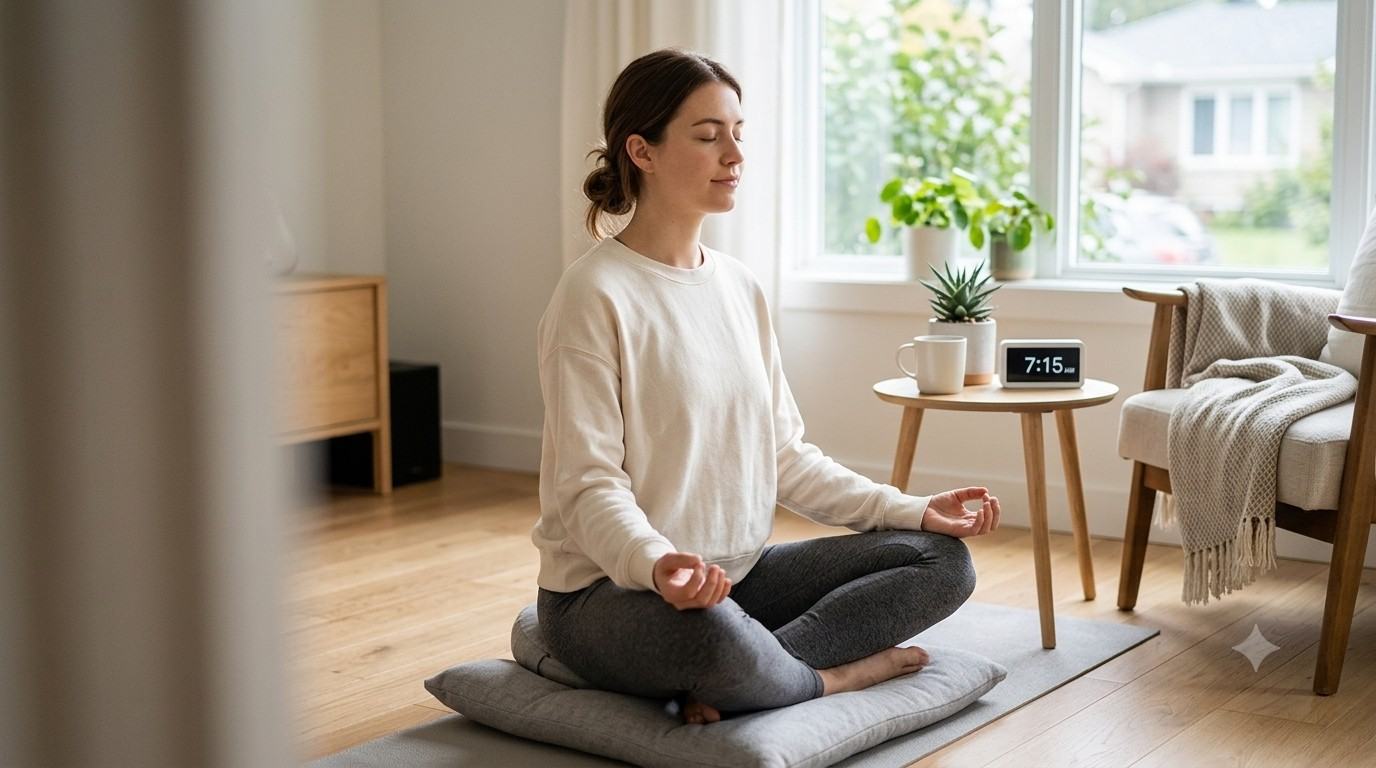
Meditation for Beginners is a very simple way to be aware of the present moment. If you are new to the world of meditation, you can just start sitting down and being aware of your breathing process. This is going to be your daily routine sooner or later.
If you would like to know how to start meditating, you should remember that there is no need for any special equipment, flexibility, or additional time for this activity; all you need is silence.
How to Start Meditating as a Beginner
The process of meditation starts by finding a calm and comfortable place where you will sit with your spine straight. Focus on your breathing, which is naturally done. Begin meditating by meditating for 5 minutes each day. Whenever your mind gets distracted during meditation, simply acknowledge it and go back to your breathing process.
What Is Meditation?
Meditation is training to develop the skill of focusing and becoming conscious. One doesn't need to prevent any thought; one only needs to realise the thoughts, feelings, physical sensations, and breathing without reacting to them.
There are various kinds of meditations. Some meditations focus on breath work, some use techniques, and other types focus on mindfulness, body consciousness, concentration, and compassion.
The key thing to keep in mind while practising is that meditation is an art form that can be learned.
Why Start a Daily Meditation Practice?
With the help of daily meditation sessions, one can find a unique place in his/her day for pausing. It is common to practice meditation in order to reach inner peace, develop self-awareness and be more focused on your mind and feelings.
Research has already been made about the effects of meditation on various issues, including stress, anxiety, attention and overall well-being. However, meditation must never be considered a substitute for any kind of professional treatment.
A consistent practice may help you:
Develop greater awareness of your thoughts
Practice returning your attention to the present
Create a calming daily routine
Become more aware of breathing and body sensations
Take intentional breaks during a busy day
Develop concentration and mindful attention
Approach everyday experiences with greater awareness
The results can vary from person to person. Rather than looking for immediate dramatic changes, focus on developing a sustainable practice.
How to Meditate for Beginners: A Simple Step-by-Step Guide
If you are learning how to meditate for beginners, start with a method that is easy enough to repeat every day.
1. Choose a Realistic Time
Start by choosing a time when you are unlikely to be interrupted.
You might meditate:
After waking up
Before breakfast
During a midday break
After work
Before bedtime
The times at which one may meditate may not work for everyone. The most important thing is that the time must suit you. For individuals who are new to meditation practice, it will take them about 5 minutes a day to establish their meditation routine.
Once you get into the flow of meditation, you will take 10, 15 or 20 minutes
2. Find a Comfortable Place
One doesn’t need any room for meditation at all.
One must select a serene place where he or she won’t be interrupted and where he or she can be comfortable sitting. One can meditate no matter whether one selects to sit on the cushions or yoga mat, on a chair, or even on the floor.
With regard to sitting, it is necessary that one must adopt a proper posture to straighten up his or her spine. One’s shoulders must be relaxed and hands must be comfortable.
3. Settle Your Body
Before beginning, take a moment to notice how your body feels.
Relax your:
Shoulders
Jaw
Hands
Face
Neck
Keep your breathing normal. You don’t need to forcefully breathe deeply or go for a complicated breathing method while doing simple mindfulness meditation.
Just be aware that you are breathing.
4. Bring Attention to Your Breath
The breath can be a useful meditation object because it is always available.
Notice:
The feeling of inhaling
The feeling of exhaling
Movement in your chest or abdomen
The sensation of air moving through your nose
You do not need to change your breathing.
Your task is simply to observe it.
5. Notice When Your Mind Wanders
This is probably the most crucial part of meditation practice.
Most likely your mind will wander.
You will be thinking about work, about yourself, about the future, about sounds, or anything else. It does not mean that you are doing it incorrectly.
In case you realize that your attention has wandered:
Awareness → acceptance → bring it back to the breath.
Every time you notice your distractions and bring your attention back to your breathing, you meditate.
Do not punish yourself for thinking, since the goal is not to have an empty mind.
6. Continue for Your Chosen Time
Keep concentrating on your breathing till your time is up.
While you meditate for five minutes, there is nothing to feel guilty about not being productive enough.
It is much better to go on with what is easy and consistent than start something hard and give up pretty quickly.
At some point, you may extend the time you spend on meditation or try out another way of relaxation.
7. End the Practice Slowly
It is recommended that you should not immediately go ahead with your work once you have completed your meditation process. You must give yourself time to observe the surroundings around you.
You will need to observe yourself, the sounds surrounding you, and even the way you breathe before you open your eyes and go back to whatever you were doing.
Beginner Meditation Techniques to Try
There is no single meditation technique that works for everyone. Exploring different approaches can help you discover what feels comfortable and useful.
Breath Meditation
It would be wise to begin with the meditation of breath.
All that one needs to do here is sit down comfortably and pay attention to how the breath moves naturally.
The important thing to remember in this case is not to breathe in any particular manner.
Mindfulness Meditation
Mindfulness meditation for beginners involves paying attention to present-moment experiences with an attitude of curiosity and less judgment.
You might observe:
Breathing
Body sensations
Sounds
Thoughts
Emotions
Movement
Instead of immediately trying to change an experience, notice it as it is and return your attention to the chosen focus.
Body Scan Meditation
Body scan involves directing attention on different body parts systematically.
An individual can begin from the feet to upwards and perceive sensations such as warmth, pressure, tightness, or relaxation. It is not necessary to make any effort to feel any sensation but to merely observe.
Guided Meditation for Beginners
The process of guided meditation for beginners involves listening to the instructions being provided to you in order to get through with the practice.
It may be especially beneficial if you are not sure:
Where to concentrate
How long to meditate
What to do if you start thinking about something else
How to conduct yourself during the meditation process
Walking Meditation
Meditation is not always done while sitting.
In walking meditation, one must walk slowly and concentrate on his/her experience like feeling the ground under one’s feet, the movements of the legs and breathing.
This type of meditation can be helpful if sitting and meditating is a problem.
5-Minute Meditation for Beginners
If you are completely new to meditation, try this simple 5 minute meditation for beginners.
Minute 1 — Settle
Sit comfortably and notice your body. Allow your shoulders and face to relax.
Minute 2 — Notice Your Breath
Pay attention to each inhale and exhale without trying to control the breath.
Minute 3 — Observe
Continue noticing the breath. If thoughts appear, recognize them and gently return your attention.
Minute 4 — Expand Awareness
Notice your body and the sounds around you while maintaining a relaxed awareness.
Minute 5 — Close
Take a moment to notice how you feel. Slowly open your eyes and return to your day.
You can repeat this practice daily and increase the duration when it feels natural.
10-Minute Meditation for Beginners
After you find yourself getting comfortable, begin meditating for 10 minutes for novices.
An outline can be like this one:
Mins 1-2: Let your body relax, and notice your breathing.
Mins 3-6: Keep your focus on breathing naturally.
Mins 7-8: Notice your thoughts and emotions without getting carried away.
Mins 9-10: Return to breathing and gently conclude your meditation.
You should not be concerned about being unable to concentrate numerous times. It is a natural part of meditation.
How to Build a Daily Meditation Habit
The information pertaining to meditation is only one of the many aspects that need to be taken into consideration. Very few individuals can manage to meditate regularly.
Some pointers for beginners attempting to meditate:
Start Small
Do not begin with an hour-long practice if five minutes feels more realistic.
Starting small reduces the pressure and makes it easier to repeat the habit.
Connect Meditation to an Existing Habit
Attach meditation to something you already do.
For example:
Wake up → drink water → meditate → begin your morning
Or:
Finish work → sit quietly → meditate → start your evening
This can make your meditation routine easier to remember.
Keep Your Practice Simple
You do not need to constantly change techniques.
Choose one beginner-friendly method and practice it regularly before experimenting with others.
Use a Timer
A timer prevents you from repeatedly checking the clock.
Set your desired duration, put your attention on the practice, and allow the timer to signal the end.
Do Not Aim for Perfect Sessions
Some days your mind may feel calm. Other days it may feel busy.
Both experiences are normal.
The objective is not to have the same meditation experience every day. The objective is to continue practicing awareness.
Return After Missed Days
Missing a day does not mean your routine has failed.
If you skip a session, simply return to your practice the next day.
Consistency is built over time, not through perfection.
What Should Beginners Do When Their Mind Wanders?
A wandering mind is one of the most common challenges for new meditators.
You may sit down expecting to focus on your breath, only to start thinking about something that happened yesterday or something you need to do tomorrow.
Instead of fighting the thought, try this:
Notice the thought → avoid judging it → return to your chosen focus.
You may need to do this many times during a single session.
That repeated return is not a distraction from meditation. It is an important part of meditation practice.
Do You Need to Control Your Breathing?
Breathing difficulties are not required in basic mindfulness meditation.
One should keep breathing normally as one observes one's breath.
There are some breathing techniques in some types of meditation and yoga, but these breathing techniques are not related to observing one’s breath in novice mindfulness meditation.
One should not continue with any breathing exercise if he feels dizzy or disturbed by it.
Can You Meditate at Home?
Yes. You can practice meditation at home without creating a special meditation space.
Choose a place where you can sit comfortably and are less likely to be interrupted.
You can use:
A meditation cushion
A yoga mat
A chair
A quiet corner
A comfortable floor space
The environment does not need to be perfectly silent. Learning to notice sounds without constantly reacting to them can itself become part of your awareness practice.
Meditation for Beginners Classes
Some people prefer learning independently, while others find meditation for beginners classes helpful.
A structured class can provide:
Step-by-step instruction
Guidance on meditation posture
Different beginner meditation techniques
Opportunities to ask questions
A regular practice schedule
Support from an experienced teacher
If you are choosing a class, look for clear information about the teacher's experience, the meditation methods taught, course structure, and what beginners can expect.
For those interested in learning meditation alongside traditional yoga practices, studying with an experienced yoga school can provide a broader understanding of meditation, breath awareness, mindfulness, and yoga philosophy.
What About Kundalini Meditation for Beginners?
Kundalini meditation for beginners may involve practices associated with particular yoga traditions, including concentration, mantra, visualization, breath-related practices, or other structured techniques.
Because methods can differ considerably between traditions and teachers, beginners should learn them from a qualified and appropriately trained instructor rather than assuming every Kundalini meditation practice is the same.
If you are new to meditation, learning basic attention and mindfulness practices first can give you a useful foundation.
What Is Vipassana Meditation for Beginners?
For beginners, Vipassana meditation involves meditation focused on awareness of experience.
There is a possibility that each school would have something unique about teaching the Vipassana technique.
Before you decide to practice Vipassana meditation, it is necessary to know how your selected course is going to be organized.
Initially, it is not necessary for you to attend a highly intensive program like the retreat program.
You should try to observe your awareness daily.
Common Mistakes Beginners Should Avoid
Meditation becomes unnecessarily difficult when beginners place too many expectations on themselves.
Trying to Stop All Thoughts
Meditation is not necessarily about having a completely blank mind.
Thoughts can arise naturally. Practice noticing them without automatically following them.
Forcing the Breath
You do not need to take exaggerated breaths during basic breath awareness.
Allow the breath to remain comfortable.
Sitting Uncomfortably
Meditation does not require you to sit in a particular advanced yoga posture.
Use a chair or another supportive position if that is more comfortable.
Expecting Immediate Results
Some people notice changes quickly, while others need more time.
Approach meditation as a practice rather than a quick solution.
Constantly Changing Techniques
Trying a different technique every day can make it difficult to develop familiarity.
Give a simple method enough time before deciding whether it works for you.
How Long Should Beginners Meditate?
No time duration for meditation is prescribed for all meditators.
Initially, one may like to try meditating for 5 minutes every day. If one finds it comfortable, one can gradually increase the time duration to 10 or 15 minutes.
Some people may prefer a longer meditation duration, whereas some continue to practice meditation for a shorter duration.
The only important point is the time duration for which one can meditate comfortably and regularly.
When Is the Best Time to Meditate?
The best time to practice meditation is the time you can sustain.
The morning period can prove advantageous for those who prefer to begin their day with peace.
For those looking for a gap between their work and sleep, the evening time might suit better.
A good time for meditation could be the middle of the day when one is taking a break from work.
How Often Should Beginners Meditate?
For beginners, a short daily practice can be a practical way to develop consistency.
Try starting with:
5 minutes × 7 days a week
If daily meditation is not realistic, choose a schedule you can maintain and gradually work toward greater consistency.
The key is to keep returning to the practice.
A Simple 7-Day Meditation Plan for Beginners
If you are unsure where to begin, use this simple one-week plan.
Day 1: Five-Minute Breath Awareness
Sit comfortably and observe your natural breathing for five minutes.
Day 2: Breath + Body Awareness
Spend five minutes observing your breath and physical sensations.
Day 3: Mindful Breathing
Focus on each inhale and exhale. Notice when your attention wanders.
Day 4: Body Scan
Slowly move your attention through different areas of your body.
Day 5: Guided Meditation
Try a short guided meditation for beginners.
Day 6: Silent Meditation
Practice without audio guidance and use your breath as your focus.
Day 7: Choose Your Preferred Practice
Repeat whichever technique felt most comfortable during the week.
After seven days, continue with the method you enjoy and gradually develop your routine.
Meditation and Yoga: How They Can Complement Each Other
Although meditation and yoga are practices that are independent of each other, there are many types of yoga that study the relationship between the two practices.
It is said that yoga includes postures, breathing techniques, concentration, meditation, and philosophy. Meditation therefore, is not only limited to relaxation practice but is also practised together with yoga.
A person who is interested in the practice of yoga needs to learn meditation too.
Frequently Asked Questions
What is the easiest meditation technique for beginners?
Breath awareness is one of the simplest techniques for beginners. Sit comfortably, observe your natural breathing, and gently return your attention whenever your mind wanders.
How do I start meditating every day?
Start with a short session, such as five minutes, and connect it to an existing part of your daily routine. Consistency is generally easier when the practice is simple and realistic.
Can I meditate for only 5 minutes?
Yes. Five minutes can be a practical starting point for beginners. A short session can help you establish a routine before gradually increasing the duration.
Is guided meditation good for beginners?
Guided meditation can be useful for beginners because spoken instructions provide structure and explain what to focus on during the session.
What should I think about while meditating?
You do not need to deliberately think about something. You can focus on your breath, body sensations, sounds, or another chosen meditation object. When thoughts arise, notice them and gently return your attention.
Should I meditate in the morning or at night?
Either can work. Choose the time that fits your schedule and that you can maintain consistently. Morning and evening practices can serve different routines and preferences.
Can I meditate lying down?
You can practice some forms of meditation while lying down, particularly practices such as body scans. However, sitting may make it easier to remain alert if you tend to become sleepy.
How long does it take to learn meditation?
There is no fixed timeline. Meditation is a skill that develops through repeated practice. You can begin with a few minutes and gradually become more comfortable with the process.
What if I cannot stop my thoughts during meditation?
You do not have to stop your thoughts. Instead, notice when your mind has wandered and gently return your attention to your breath or chosen focus.
Can beginners learn meditation without a teacher?
Yes, many basic meditation practices can be learned independently. However, a qualified teacher or beginner-friendly class can provide structure, feedback, and guidance, particularly when learning more specialized practices.
Start Your Meditation Practice Today
To be precise, one of the major elements in meditation is that it shouldn’t be made hard.
Start with the permission to allow yourself to practice for five minutes. You can simply sit comfortably, breathe, and begin wherever you may be. If your mind starts wandering off at any given time, all you have to do is bring your mind back to track. If at any time you end up forgetting about your practice, simply pick where you left off.
Eventually, five minutes could be your habit.
But if you wish to explore more in meditation, then taking classes of yoga and meditation will be the right path.