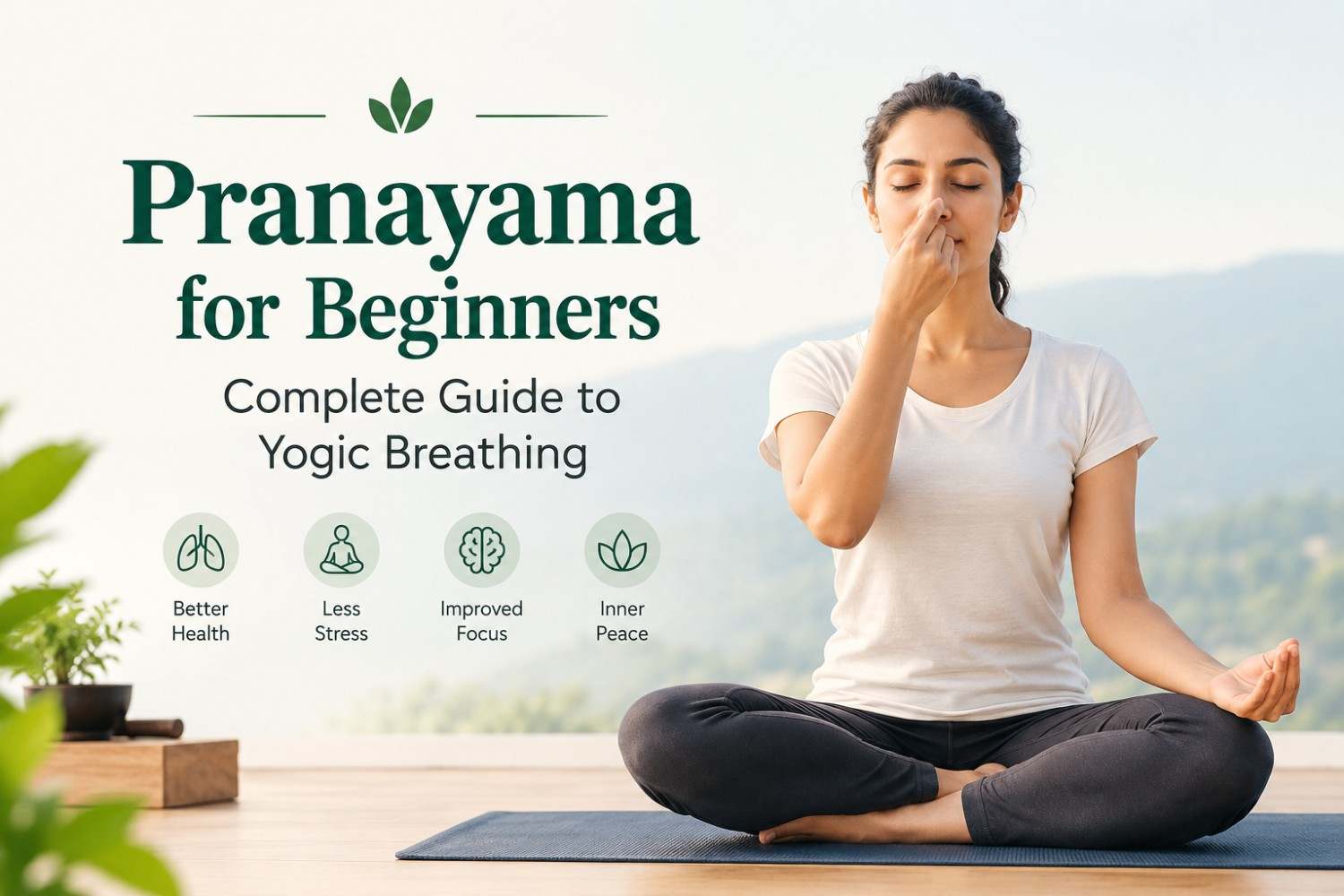
Pranayama for Beginners involves learning to consciously regulate the breath through different breathing techniques, including controlled inhalation, exhalation, and, in some practices, breath retention. If you are new to pranayama, start with simple and gentle techniques such as diaphragmatic breathing, Dirgha Pranayama, Nadi Shodhana, Bhramari, and Ujjayi breathing. These practices can help you develop breath awareness and build a comfortable, consistent breathing routine.
If you are new to yoga practice, pranayama can be a good way to start paying attention to your breath and build the habit of regular breathing.
Beginners can start with 5–10 minutes of gentle breathing each day. Begin with natural breath awareness or diaphragmatic breathing, then gradually explore simple pranayama techniques such as Dirgha, Nadi Shodhana, Bhramari, and Ujjayi.
What Is Pranayama for Beginners?
Pranayama is one of the oldest methods in Yogic practice, where conscious control of breathing is attained.
The basic element of Pranayama relies on the concept of prana, which is a manifestation of life energy or life force, and ayama, which is regulation, exp
ansion, and elongation.
Pranayama, as compared to the eight traditional limbs of Yoga, falls between asanas and pratyahara, dharana, and dhyana.
Whereas in modern times pranayama is referred to as breathing exercises, pranayama in ancient times had more roles other than just breathing exercises due to the regulation of breathing.
Nonetheless, when practising pranayama for the first time, the initial step to take is breathing regulation.
Why Is Pranayama Important in Yoga?
The breathing process is closely connected with physical activity, attention and the emotional state of a person. During stress, people breathe very quickly and briefly. During the relaxation process, breathing becomes slow and regular.
Pranayama is based on special breathing exercises and provides knowledge of such processes.
There are numerous studies showing that slow breathing influences autonomic and cardiovascular parameters, such as heart rate variability. There are other studies that investigate pranayama and show different physiological effects of various breathing techniques. But scientists are still studying the influence of each particular breathing technique.
For a beginner, the main benefits of learning pranayama include:
Greater awareness of breathing
A more consistent breathing routine
Improved ability to relax
Better preparation for meditation
Greater concentration during yoga practice
A stronger connection between breath and movement
Pranayama should be viewed as a complementary wellness practice rather than a replacement for medical care.
What Are the Benefits of Pranayama for Beginners?
Appropriate breathing exercises might help promote relaxation, stress control, body awareness, and concentration.
There is research on the effects of slow breathing that shows that relaxation and decreased arousal have been documented. Nevertheless, results differ depending on the type of breathing exercise used and the participants being tested.
Physical Benefits
Gentle pranayama may help beginners:
Develop better awareness of breathing patterns
Coordinate breathing with movement
Practise slower, more controlled breathing
Develop respiratory awareness
Prepare the body for meditation and yoga
Mental Benefits
A regular practice may support:
Relaxation
Focus and attention
Mental clarity
Greater awareness of stress responses
Preparation for meditation
Emotional Benefits
However, breath control might also be considered an effective stress management tool that brings a sense of relaxation.
It should be noted that scientific research results do not promise that pranayama would treat such illnesses as anxiety disorders, depression, hypertension, or any other diseases. Consult with the appropriate specialist regarding your disease.
How to Do Pranayama for Beginners: Step by Step
If you are wondering how to do pranayama for beginners, start with a comfortable seated position and avoid forcing the breath.
Step 1: Choose a quiet place
Find a comfortable, well-ventilated space where you can practise without interruptions.
Step 2: Sit comfortably
Sit on a yoga mat, cushion, or chair. Keep your spine comfortably upright without creating unnecessary tension.
Step 3: Observe your natural breathing
Before changing the breath, spend one or two minutes simply noticing your inhalation and exhalation.
Step 4: Begin with gentle breathing
Try slow, comfortable nasal breathing. Do not force deeper or longer breaths than feel natural.
Step 5: Introduce one technique
Choose one beginner-friendly technique rather than trying several advanced methods in one session.
Step 6: Stop if you feel uncomfortable
Dizziness, breathlessness, chest discomfort, or unusual discomfort are reasons to stop and return to normal breathing.
Step 7: Practise consistently
Five to ten minutes of regular practice is a reasonable starting point for many beginners.
6 Simple Pranayama Exercises for Beginners
There are many pranayama techniques, but beginners do not need to learn them all at once.
The following practices provide a simple starting point.
1. Diaphragmatic Breathing
Diaphragmatic breathing, sometimes called abdominal breathing, is a useful foundation for beginners because it helps you notice how the breath moves through the body.
How to practise
Sit or lie comfortably.
Place one hand on your abdomen.
Breathe gently through your nose.
Notice the abdomen moving naturally as you inhale.
Exhale slowly without forcing the breath.
Continue for 3–5 minutes.
The goal is not to make every breath extremely deep. Focus on keeping the breath comfortable and relaxed.
2. Dirgha Pranayama — Three-Part Breath
Dirgha, or three-part breathing, introduces beginners to a fuller awareness of the breath.
It is traditionally practised by bringing awareness sequentially to the abdomen, rib cage, and upper chest.
How to practise
Sit comfortably.
Inhale slowly through the nose.
Notice expansion around the abdomen.
Continue noticing expansion through the ribs and upper chest.
Exhale slowly and comfortably.
Repeat for several rounds.
Keep the breath smooth rather than trying to fill the lungs beyond a comfortable capacity.
3. Nadi Shodhana — Alternate Nostril Breathing
Nadi Shodhana is one of the most commonly taught traditional pranayama techniques.
A simple beginner version alternates the nostril through which you inhale and exhale.
How to practise
Sit comfortably with your spine upright.
Use your right hand to gently control the nostrils.
Close the right nostril and inhale through the left.
Close the left nostril and exhale through the right.
Inhale through the right.
Close the right nostril and exhale through the left.
Repeat for 5–10 comfortable rounds.
Beginners should initially practise without prolonged breath retention.
4. Bhramari Pranayama — Humming Bee Breath
Bhramari is traditionally practised by producing a gentle humming sound during exhalation.
How to practise
Sit comfortably.
Take a gentle breath in through the nose.
Exhale slowly while making a soft humming sound.
Notice the vibration around the face and head.
Repeat several times.
Keep the sound comfortable rather than loud or forced.
5. Ujjayi Pranayama for Beginners
Ujjayi pranayama for beginners can be introduced once you are comfortable with basic nasal breathing.
Ujjayi is traditionally associated with a soft, controlled sound created by gently narrowing the throat during breathing.
How to practise Ujjayi
Sit comfortably or practise during a gentle yoga sequence.
Close your mouth and breathe through the nose.
Slightly narrow the throat.
Create a quiet, smooth sound.
Keep both inhalation and exhalation controlled.
Continue for a few comfortable rounds.
The sound should be subtle. If the throat feels strained, relax the technique.
Ujjayi is especially familiar to practitioners of Vinyasa and other movement-based yoga styles.
6. Sama Vritti — Equal Breathing
Sama Vritti is commonly taught as equal-length inhalation and exhalation.
How to practise
Inhale gently for a comfortable count.
Exhale for the same count.
Continue for several rounds.
Gradually increase the duration only if the breathing remains relaxed.
For example, you might begin with a comfortable 4-count inhale and 4-count exhale.
Do not increase the count simply to make the practice more challenging.
Which Pranayama Is Best for Beginners?
There is no single pranayama technique that is best for every beginner.
A simple progression is:
If you are completely new to pranayama, begin with diaphragmatic breathing or simple breath awareness before progressing to more structured techniques.
A Simple 10-Minute Pranayama Routine for Beginners
You do not need an hour-long session to begin.
Try this simple routine:
This routine can be adjusted according to your comfort and experience.
The most important principle is consistency rather than intensity.
When Is the Best Time to Practice Pranayama?
Traditionally, pranayama is often practised during quiet periods of the day, particularly in the morning.
However, the best time for a beginner is a time when regular practice is realistic.
You may practise:
In the morning
Before meditation
Before a gentle yoga session
During a quiet afternoon break
In the evening with gentle breathing practices
Avoid practising immediately after a heavy meal.
If you are practising before sleep, choose a gentle, relaxing technique rather than an intense or stimulating practice
Should You Practise Pranayama Before or After Yoga?
The answer depends on your practice.
In a traditional yoga sequence, pranayama is often practised after asana and before meditation. However, gentle breathing exercises can also be practised independently.
For beginners, a simple sequence can be:
Asana → Pranayama → Meditation → Relaxation
If you are practising Ujjayi during a movement-based class, it may naturally be integrated throughout the physical practice.
Common Pranayama Mistakes Beginners Make
Learning pranayama is less about forcing the breath and more about developing awareness.
Avoid these common mistakes:
1. Forcing the breath
Your breathing should remain smooth and controlled. Do not compete with yourself.
2. Holding the breath too early
Breath retention, or kumbhaka, is an important part of some traditional practices, but beginners should not rush into prolonged retention.
3. Taking excessively deep breaths
“Deeper” does not automatically mean “better.” Comfortable breathing is more important.
4. Learning too many techniques at once
Choose one or two techniques and become familiar with them before adding more.
5. Ignoring discomfort
If you feel dizzy, faint, unusually breathless, or uncomfortable, stop the exercise and return to natural breathing.
6. Practising immediately after a heavy meal
Allow enough time after eating to practise comfortably.
7. Expecting instant results
Pranayama is a practice. Its value comes from regular, mindful repetition rather than trying to achieve dramatic effects in one session.
Is Pranayama Safe for Beginners?
Anyone can engage in breathing exercises, although not all types of breathing exercises would suit all individuals. As mentioned by the NCCIH, it is recommended that people, especially beginners, refrain from engaging in strenuous breathing exercises and learn yoga from qualified instructors. Pregnant women and patients with particular medical conditions need to take care.
Beginners should remember:
Never force the breath.
Avoid prolonged breath retention without appropriate instruction.
Stop if you feel dizzy or unwell.
Begin with gentle techniques.
Learn advanced pranayama from a qualified teacher.
Speak with your healthcare professional if you have a medical condition or are unsure whether a breathing practice is appropriate for you.
Important: Pranayama should not replace medical diagnosis or treatment.
Pranayama for Beginners in Hindi: Basic Terms to Know
If you are searching for pranayama for beginners in Hindi, understanding a few Sanskrit terms can make traditional yoga instructions easier to follow.
Prana
Often translated as life force or vital energy.
Ayama
Commonly associated with extension, expansion, or regulation.
Puraka
Inhalation.
Rechaka
Exhalation.
Kumbhaka
Breath retention.
Nadi
A traditional yogic term referring to subtle channels through which prana is described as flowing.
Shodhana
Purification or cleansing.
This terminology is useful when reading traditional yoga texts or studying pranayama with a teacher.
How Long Should Beginners Practise Pranayama?
Start with approximately 5–10 minutes per day and increase gradually if the practice remains comfortable.
You do not need to practise every technique every day.
A beginner might follow this progression:
Week 1:
5 minutes of natural breath awareness and diaphragmatic breathing.
Week 2:
Add Dirgha Pranayama.
Week 3:
Introducing Nadi Shodhana.
Week 4:
Explore Bhramari or Ujjayi with appropriate instruction.
The timeline is only a framework. Progress according to your comfort and experience.
Pranayama vs. Normal Deep Breathing: What's the Difference?
Normal deep breathing usually refers to intentionally taking slower or fuller breaths.
Pranayama is broader.
It involves structured methods for regulating the breath, which may include:
Inhalation
Exhalation
Breath ratios
Nostril patterns
Sound
Breath retention
Attention and awareness
Traditional pranayama therefore goes beyond simply “taking a deep breath.
Can Beginners Learn Pranayama Without a Teacher?
Some gentle techniques can be learned independently with careful instructions.
However, working with a qualified yoga teacher becomes particularly valuable when learning:
Advanced breath retention
Strong or rapid breathing techniques
Complex ratios
Bandhas
Traditional pranayama sequences
NCCIH recommends qualified instruction for people who are new to yoga and cautions beginners against forceful breathing practices.
For beginners, professional guidance can also help you understand whether your technique is comfortable and appropriate.
Frequently Asked Questions
What is the easiest pranayama for beginners?
Diaphragmatic breathing and simple breath awareness are among the easiest places to start. Dirgha Pranayama can be introduced next because it teaches awareness of different areas of the breath.
How do I start pranayama as a beginner?
Begin with 5–10 minutes in a quiet place. Sit comfortably, observe your natural breathing, and then practise one gentle technique such as diaphragmatic breathing, Dirgha, or Sama Vritti.
Can I practise pranayama every day?
Many people can incorporate gentle breathing practices into a daily routine. Start with a short, comfortable session and adjust the practice according to your needs and experience.
Which pranayama is best for beginners?
There is no universal “best” technique. Diaphragmatic breathing, Dirgha, Nadi Shodhana, Bhramari, Ujjayi, and Sama Vritti can all serve different purposes in a beginner's practice.
Is Ujjayi pranayama good for beginners?
Ujjayi can be introduced to beginners, particularly during gentle yoga practice. Start with a subtle throat constriction and a soft sound rather than trying to make the breath loud or forceful.
Can pranayama help with stress?
Slow breathing practices may support relaxation and influence autonomic nervous-system activity. Research suggests that slow breathing can be associated with physiological and psychological changes related to relaxation, although results vary between techniques and individuals.
How many minutes should a beginner practise pranayama?
Starting with 5–10 minutes is reasonable for many beginners. The session can gradually become longer as comfort and familiarity develop.
Should I practise pranayama on an empty stomach?
Many traditional yoga practices are taught away from heavy meals because breathing exercises can be uncomfortable with a full stomach. If you have recently eaten, allow enough time for digestion before practising.
Can I practise pranayama before sleep?
Gentle, slow breathing may be appropriate as part of a relaxing evening routine. Recent research has also investigated slow breathing before bedtime and its potential relationship with sleep outcomes.
Can pranayama replace medical treatment?
No. Pranayama is a complementary yoga practice and should not be used as a substitute for professional medical diagnosis or treatment.
A Beginner's Pranayama Checklist
Before starting your practice, ask yourself:
Am I sitting comfortably?
Is my spine relaxed and upright?
Is my breathing smooth?
Am I practising without forcing?
Have I avoided a heavy meal immediately beforehand?
Am I starting with a simple technique?
Am I stopping if I feel uncomfortable?
Am I practising consistently rather than intensely?
If the answer is yes, you are ready to begin.
Final Thoughts
Beginner pranayama need not necessarily be an extremely strenuous form of exercise.
It begins with focusing on the act of breathing. Incorporate some exercises involving breathing such as diaphragmatic breathing, Dirgha Pranayama, Nadi Shodhana, Bhramari, Ujjayi, and Sama Vritti.
The focus should not necessarily be on strenuous breathing or complicated forms of pranayama but on establishing a relationship with one’s breathing.
As you become more adept at performing pranayama with time, you will realize that pranayama is quite simple under the guidance of a yoga teacher.
Further yoga research is exploring the impact of breathing techniques on stress, the autonomic system, sleep, and other facets of well-being. The current findings are encouraging in certain respects but do not provide grounds for making general health claims.
Begin with one breath and one easy technique at a time.