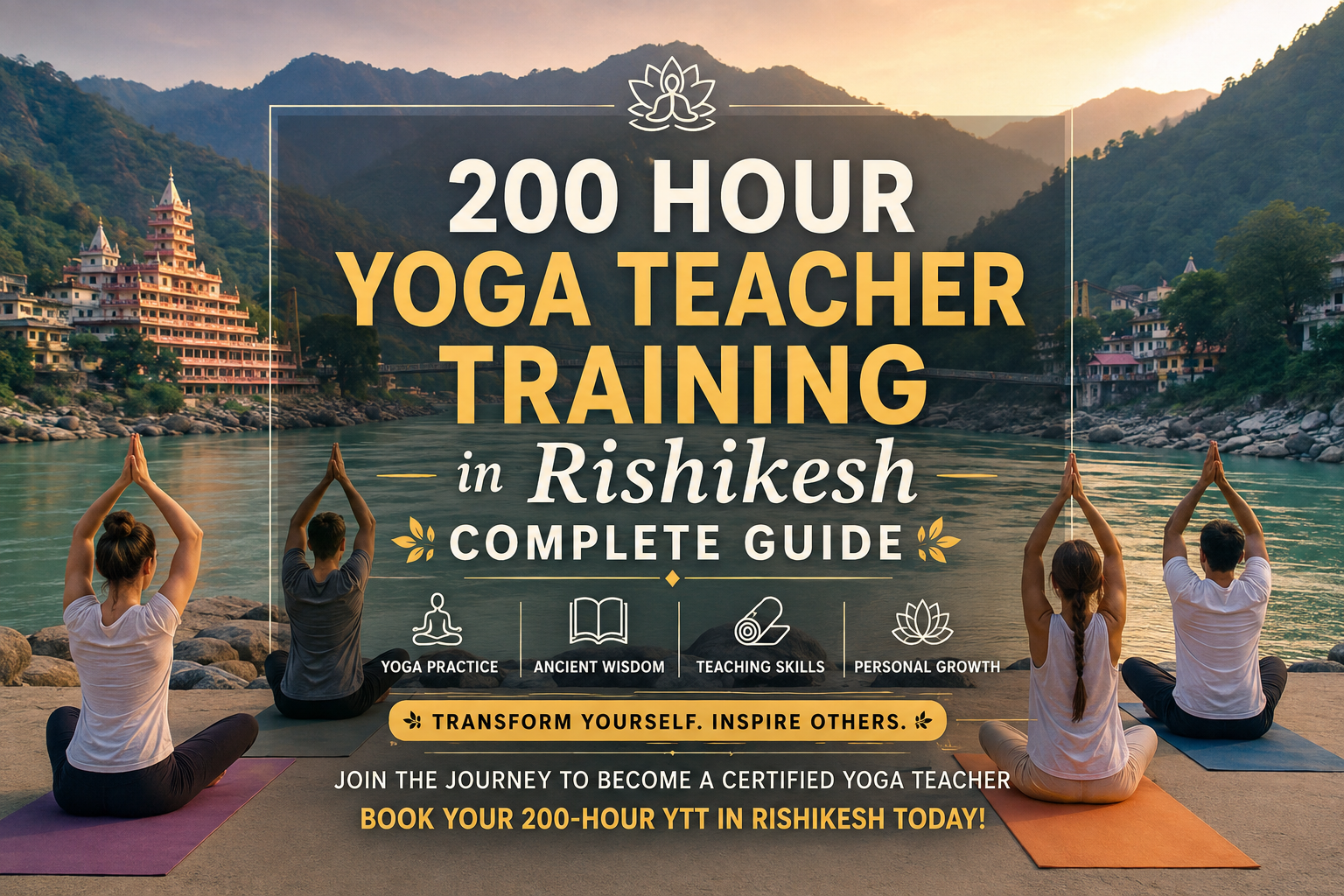
A 200 Hour Yoga Teacher Training in Rishikesh: These initial training courses serve as a basic foundation which includes both asana practice as well as anatomy, philosophy, pranayama, meditation, instructional design as well as teaching itself. Specific training curricula differ amongst different training schools but often provide immersive as well as residential courses. An RYS 200 (Yoga teacher training program) school would qualify all its students after 200 hours of instruction so that these students may apply for RYT 200 (Registered yoga instructor) credential.
Table of Contents
Introduction
There is a lot more to choosing a yoga teacher training course than finding one that is advertised as having 200-hours.
You are spending weeks of your life learning how to perform, understand and share yoga to other people.
The school, teachers, syllabus, teaching practice, accommodation, certification methodology, assessment structure, and type of certificate can all impact on your practice.
The chance for Indian, Spanish, Russian, Chinese and other students to come to the place strongly associated with India's living traditions of yoga can be beneficial. For international students, Rishikesh can be more than just marketing and location when considering a school.
This guide explains what a 200-hour program involves, who it is suitable for, what you can expect to study, how certification works, and what to check before choosing a 200 Hour Yoga Teacher Training Course in Rishikesh.
What Is a 200 Hour Yoga Teacher Training in Rishikesh?
What does a 200 Hour Yoga Teacher Training mean?
200 Hour Yoga Teacher Training: A 200-hour Yoga Teacher Training provides you with the fundamentals ofYoga education if you wish to delve more deeply into your personal practice and if the program, as well as the certification process, allows you to begin to offer the present of Yoga to others as an instructor. A comprehensive curriculum commonly brings together: Asana practice and technique Pranayama Meditation Yoga philosophy and humanities Teaching methodology Sequencing and class planning Alignment and observation Practicum or teaching practice Professional and ethical considerations The curricula can vary from one school to another depending on the accreditation body. However, the RYS 200 standard regulates the curricula that must be taught at a 200 hour yoga school. According to the Yoga Alliance, you will be able to obtain the RYT 200 (Registered Yoga Teacher) certification after having successfully completed your 200 hour yoga training program at an RYS 200.
Is 200 hours the same as 200 classes?
No, “200 hours” has nothing to do with 200 classes. A real teacher’s program must comprise both the physical part (Asana classes), and program, discussion, observation and teaching practices on theoretical and practical aspects of the education.
Who is a 200-hour YTT for?
A 200-hour course can be suitable for: Beginners who want structured Yogism education Regular practitioners who want deeper knowledge Aspiring yoga teachers Professionals interested in adding yoga teaching skills Students seeking an immersive experience in India Being a professional Yogism does not involve knowing the latest contortion postures, there are training programs which should progressively build students' understanding, awareness as well as instructions skill as compared to making body flexibility a primary skill for determining abilities.
Why Choose a 200 Hour Yoga TTC in Rishikesh?
Because yoga is so integral to Rishikesh's culture, it is a primary hub for yogic education and practice. The city also offers to the foreign students a space to learn yoga in a way that extends beyond the confines of a studio space.
1. Study yoga in a traditional Indian setting
Choosing a meditative practice program in Rishikesh gives your Studies a surrounding of ashrams, temples, yoga teachers, disciplines and the Ganga does not always make one school a more excellent school over the another yet the environment offers extra depth in studies.
2. Learn beyond physical postures
A well-designed 200 Hour Yoga Teacher Training in India should not reduce yoga to stretching or exercise.
Students may study how physical practice connects with:
Breath
Concentration
Meditation
Philosophy
Ethics
Awareness
Teaching
Self-discipline
3. Build practical teaching confidence
Knowing how to perform a yoga pose is different from knowing how to teach it. Teacher training should give you opportunities to practise: Giving clear verbal instructions Demonstrating postures Observing students Offering appropriate modifications Sequencing classes Managing time Creating a supportive learning environment This practical component is one of the most important differences between personal yoga classes and teacher training.
4. Meet an international yoga community
Rishikesh attracts students from different countries and backgrounds. For international students, that can create useful opportunities to learn how yoga is understood and practised across cultures.
How Does a 200 Hour Yoga Teacher Training Work?
Although every school has its own timetable, a typical immersive program combines practice, classroom learning and teaching preparation
Asana and practical yoga
Students study postures through technique, alignment, variations and application. Depending on the school's approach, this may include Hatha Yoga, Ashtanga Vinyasa, Vinyasa or other traditions.The goal should not simply be to “do more poses.” You should understand how to demonstrate and explain practices appropriately.
Pranayama and meditation
Pranayama introduces structured approaches to breath awareness and regulation, while meditation develops concentration and awareness.
These subjects also help students understand that yoga education involves more than physical movement.
Yoga philosophy
Courses may introduce foundational concepts from classical yoga texts and traditions, including subjects connected with the Yoga Sutras, Bhagavad Gita, yamas and niyamas.
The value of philosophy comes from understanding its context and considering how it relates to practice and responsible teaching.
Anatomy and physiology
Anatomy helps aspiring instructors understand movement and the human body. Useful areas can include: Major joints and movement patterns Muscles involved in movement Basic biomechanics Alignment principles Physical limitations Safe modifications Anatomy education does not make a yoga Instructor a doctor or physiotherapist. Teachers should understand the boundaries of their professional scope.
Teaching methodology and practicum
Teaching methodology focuses on turning knowledge into instruction. Students may learn how to: Plan a class Demonstrate a posture Give verbal cues Observe students Modify practices Sequence a session Teach a complete class Practical teaching is particularly valuable because confidence comes from supervised practice, not simply from reading theory.
Certification: Yoga Alliance vs Government of India
What is Yoga Alliance certification?
Yoga Alliance is an international professional organization with registration pathways for yoga teachers and schools.
According to Yoga Alliance, in order to obtain a RYT 200 credential, “the teacher must have completed a 200-hour training with a RYS delivering this training under this training in your desired language”. This means that if a 200 hour course is your intention when training for your RYT200 designation, be sure you are researching if the school is a Registered Yoga School before enrolling your or their "200-hour training course” to prevent any disappointments.
What is the Government of India's Yoga Certification Board?
Yoga Certification Board (YCB) comes under the Ministry of AYUSH, the Government of India. The official website of YCB states: "YCB is a government body which issues Yoga Certificates on a fixed set of standards". YCB follows its own structure of certification and has different certifications like Yoga Protocol Instructor, Yoga Wellness Instructor and Yoga Teacher & Evaluator. Thus "yoga certification course by Government of India" is NOT the other name of a yoga alliance RYT 200. Before enrolling, ask the school: Which organization issues the certificate? Is the school currently registered with Yoga Alliance? Is the specific 200-hour program registered as RYS 200? Is the program connected to YCB, and if so, how? What documentation will you receive after successful completion? That simple verification can prevent confusion later.
Step-by-Step Guide to Choosing the Right 200 Hour YTT
Step 1: Define your goal
First decide why you want to take the course.
Are you primarily looking to:
Become a yoga Instructor ?
Deepen your personal practice?
Study traditional yoga?
Build confidence teaching others?
Prepare for further training?
Your objective will help determine the type of school and curriculum you need.
Step 2: Check the curriculum
Do not choose a course solely because it says “200 hours.” Review whether the program includes meaningful study of: Asana Pranayama Meditation Philosophy Anatomy Teaching methodology Practicum Ethics A curriculum should show what you will actually learn rather than simply listing attractive yoga terms.
Step 3: Verify the certification pathway
Especially if you are an international student.
In case you would like an RYT 200 route, ask the school for its up-to-date RYS 200 status with Yoga Alliance. Yoga Alliance also has requirements concerning certificates for registering with RYT: registered school name, designation of the training, date of completion and the legal name of trainee.
In case you are interested in Government of India certification, check the corresponding YCB route in an independent channel of the official YCB information.
Step 4: Research the teachers
Look at the teachers who will actually conduct the program.
Check:
Their qualifications
Teaching experience
Areas of specialization
Teaching approach
Whether they teach the majority of the course
Whether students receive practical feedback
A famous school name is less useful if you do not know who will teach you.
Step 5: Compare the complete package
Do not compare prices without comparing inclusions.
Ask whether the advertised fee includes:
This gives you a much more realistic basis for comparison.
Step 6: Review the daily schedule
You will likely find your 200 Hour yoga TTC in Rishikesh tough at times. Request to have an example of the course schedule and what proportion of your week includes physical practice time, study, meals, relaxation time, self-study time and training time. It will generally be strenuous but well ordered to provide some opportunity for effective study.
Step 7: Ask questions before paying
Before making a booking, ask the school for clear answers about: Start and end dates Accommodation Meals Class language Certification Trainer qualifications Assessment Refund policy What is not included Required documents for international students Getting these details in writing can save unnecessary problems later.
Frequently Asked Questions
1. How long does a 200 Hour Yoga Teacher Training in Rishikesh take?
A 200-hour course commonly takes around three to four weeks in an immersive format, although the exact duration depends on the school's schedule and delivery model. Current Rishikesh programs vary, with examples ranging from roughly 24 to 28 days.
2. Can beginners join a 200-hour yoga teacher training?
Yes, many 200-hour programs are designed for beginners as well as existing practitioners. However, eligibility and recommended experience vary by school, so check the specific course requirements before enrolling.
3. Do I need to be flexible to join a 200-hour YTT?
No. Advanced flexibility is not a prerequisite for becoming a yoga teacher. The more important qualities are willingness to learn, consistency, body awareness and openness to feedback
4. What do you learn in a 200 Hour Yoga Teacher Training Course in Rishikesh?
You typically study asana, pranayama, meditation, yoga philosophy, anatomy and physiology, teaching methodology, sequencing, alignment and practical teaching. The exact syllabus varies by school.
5. Is a 200-hour YTT enough to become a yoga teacher?
A 200-hour program can provide foundational teacher training. If you are pursuing the Yoga Alliance RYT 200 credential, however, the training must meet the applicable Yoga Alliance requirements and be completed through an eligible RYS 200.
6. Is a 200-hour Yoga TTC the same as a Government of India yoga certification?
No. A Yoga Alliance RYT 200 pathway and certification through India's Yoga Certification Board are separate systems. YCB operates under the Ministry of AYUSH and has its own certification levels and requirements.
7. What is the difference between a 200-hour YTT and a 300-hour YTT?
Typically a 200 hour program is the beginning path of teacher training and a 300 hour program is advanced training that is appropriate for those who have a foundation certification. Yoga Alliance does look at RYT 500 as a path made up of 500 hours of a teacher training, which would include taking a 500 hour program or approved 200 and 300 hour training sessions.
8. What yoga styles are taught in a 200-hour YTT in Rishikesh?
It varies quite a lot from one school to another. Hatha and Ashtanga Vinyasa are the most frequent. Some schools also integrate Vinyasa Flow, meditation and pranayama and other classical methods. The syllabus will always be specified.
9. What should I check before choosing a yoga school in Rishikesh?
Check the curriculum, teachers, certification pathway, school registration where relevant, accommodation, meals, practical teaching opportunities, assessment process, reviews and total cost.
10. Can international students join a 200 Hour Yoga Teacher Training in India?
Yes, international students commonly study yoga in India, but they should independently verify current travel, visa and entry requirements applicable to their nationality before travelling.
11. Is Rishikesh better than other destinations for yoga teacher training?
There is no one “best place to go.” Rishikesh may appeal to you if you desire to experience Yoga in an Indian and a Traditional, Indian way. After that, the quality of the yoga school and teacher training program is even more important than the destination name alone..
12. What should I bring to a 200-hour yoga teacher training?
You will need a backpack, warm yoga clothing, shampoo and soap, water bottle, note pad, pens, journal, suitable shoes and anything specific for personal comfort needed during your retreat. Ask your yoga school for its advice and packing list.
What Is a Typical Day Like During 200 Hour Yoga Teacher Training?
What YourTypical day looks like for a 200 Hour Yoga Teacher Training in Rishikesh It consistsof asana practice, theory, self-study, meditation, andteaching practice. A typical schedule helps to provide an effective learning process that builds a personal yoga practice while teaching the skills that will be used to teach others.
While the exact timetable varies by school, a typical training day may look like this:
| Time | Activity |
|---|---|
| 5:30–6:00 AM | Wake up and prepare for the day |
| 6:00–7:30 AM | Morning yoga practice, asana and alignment |
| 7:30–8:30 AM | Breakfast and personal time |
| 9:00–10:30 AM | yoga philosophy, anatomy or teaching methodology |
| 10:45 AM–12:00 PM | Pranayama, meditation or theory class |
| 12:00–1:00 PM | Lunch and rest |
| 2:00–3:30 PM | Anatomy, philosophy or teaching techniques |
| 3:45–5:15 PM | Practical yoga and sequencing |
| 5:30–6:30 PM | Meditation, pranayama or evening practice |
| 6:30 PM onward | Dinner, self-study and personal time |
What Do Students Learn During the Day?
Yes, generally speaking. Typically a 200hr programme is a more intensive and regulated experience than a traditional yoga holiday, and expect a good few hours of learning and practice every day. You also, however, expect time to take your meals, rest, to study and for your own personal activities. The specific timetable, length of classes and daily activities will be specific to the yoga school. Tip: Ask the school to share its current schedule with you before you invest time and money in a 200-hour Yoga teacher training program. That’s how you will know to what extent practice, theory, teaching philosophy, breaks and self-practice hours is emphasized. The training is far beyond physical yoga. Through the learning and practice of the following concepts, you will gradually deepen your understanding of yoga: Pranayama (breathing techniques): Learn traditional breathing methods and their uses. Meditation: Train the ability to concentrate, enhance your self-awareness, and develop a habit of meditation. Yoga philosophy: Master the concepts, ethics, and core readings of traditional yoga. Anatomy and physiology: Understand how the human body works and the effect of the yoga posture on it. Teaching methodology: Develop the ability to demonstrate, instruct, create classes, and communicate with people. Teaching practicum: Practice teaching with the guidance of certified Yoga Teachers
Asana practice (postures): Posture details, alignments, modifications and safety techniques.
Conclusion
A 200 Hr Yoga Teacher Training in Rishikesh can be a valuable initial foray for those who would like to take their learning of Yoga further and develop some basic skills of teaching.
Ultimately the choice is not that you must study Yoga Teacher Training Rishikesh. It comes down to a School which suits your aspirations for the learning, Teachers, Practice sessions, Certificate path, board, accommodation.
In 200Hr Yoga Teacher Training, you would be doing best by watching out to know the differences for your 200 hr yoga ttc in India which are: the school’s certificate, the 200 hrs with an RY T200 Yoga Alliance path and Yoga Certification Board by the Govt of India certificate.
Understand exactly all aspects before choosing and ensure your choice makes the most out of learning.