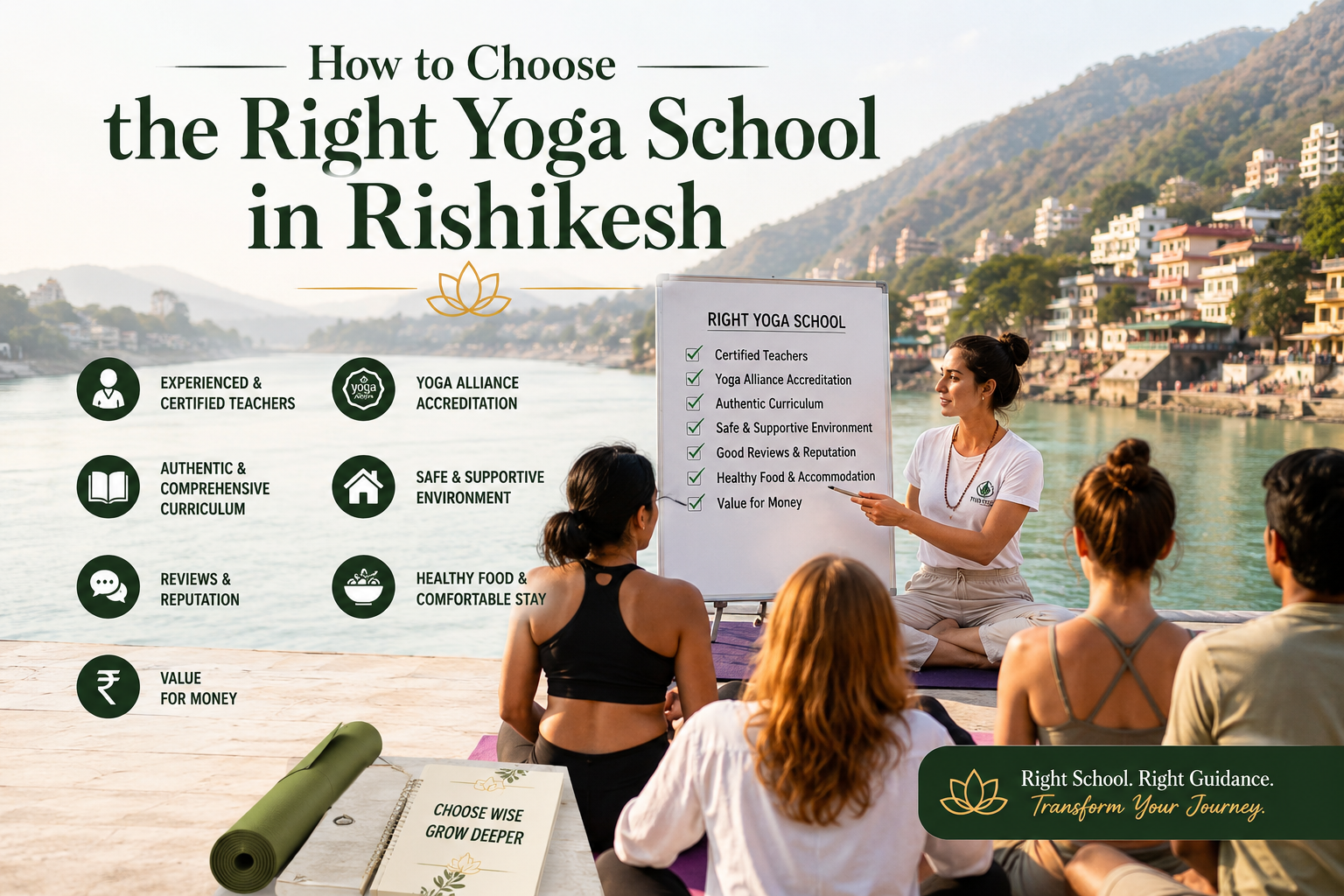
Choose your yoga school in Rishikesh the way you select: certificate offered, teachers, curriculum and their teaching method, batch sizes, daily timetable, accommodation facilities, food, all costs, user feedback and cancellations policies and other more criteria and after that find such an in accordance as your expectation: from beginner spiritual discipline class or from self practice or from Yoga TTT or YIC, etc and take confirmed knowledge about the details of diploma.
| S.No. | Table Of Content |
|---|---|
| 1 | Introduction |
| 2 | What is a Yoga School in Rishikesh |
| 3 | Why does choosing the Right Yoga School Matter? |
| 4 | How to Evaluate a Yoga School in Rishikesh |
| 5 | Step-by-Step guide to choosing a Yoga School |
| 6 | Frequently asked Questions |
| 7 | Conclusion |
Introduction
Selecting a yoga school in Rishikesh can be fun, and yet also very challenging.
Rishikesh has been long established as the ascetic practice, meditation, and spiritual study capital of the world, with Uttarakhand Tourism listing it as the yoga and meditation capital of India with many ashrams and centers welcoming people from around the globe. The result is that there's a lot of competition, and an array of schools, courses, and styles of meditative exercise for a student to differentiate from.
A slick website or impressive photos will not explain the real learning experience. Therefore, it is essential to examine what happens once you arrive: who the teacher is; how a curriculum has been set; how big the teaching groups are; how much practical teaching time you will get; what certificate the course offers; and indeed what is included in the price; what is expected of students; and what happens should your plans for some reason go awry. This guide outlines practical considerations and questions to answer prior to making a commitment.
What Is a Yoga School in Rishikesh?
“Rishikesh Yoga School is an educational center that offers yogis with programs where they may learn spiritual discipline through practices including Asana, Pranayama, and meditation, as well as in Yoga Philosophy, Anatomy, and Teaching Styles.” Courses are available at various levels; some Schools will have drop-in classes, while others offer fully-integrated residential teacher trainings in Rishikesh consisting of 100 hours, 200 hours, and more” For illustration, AM currently presents 100 hour, 200 hours, 300 hour, 500 hour plans along with some other ascetic practice and Wellness Programs.
Yoga school vs. yoga class vs. yoga teacher training
These terms are related but not identical.
| Option | Usually suitable for | Main purpose |
|---|---|---|
| Yoga class | Beginners or regular practitioners | Practice and improve specific techniques |
| Short yoga course | Visitors with limited time | Explore yoga more intensively |
| Yoga retreat | People seeking practice plus rest/immersion | Wellness, reflection and practice |
| 200-hour teacher training | Aspiring teachers and serious practitioners | Structured foundational teacher education |
| 300-hour training | Practitioners with previous training | Advanced study and teaching development |
| 500-hour pathway | Students seeking more extensive education | Combined or advanced teacher training |
The important point is that the best yoga school for one student may be the wrong school for another.
Someone looking for a peaceful week of spiritual discipline classes does not necessarily need the same curriculum, schedule or certification as someone planning a career as a yoga teacher.
Why Does Choosing the Right Yoga School Matter?
A yoga teacher training course can require a significant investment of time, money and travel. More importantly, the school influences how you understand yogism and how confidently you can practise or teach it afterward.
1. The teacher matters more than the brochure
A curriculum can look excellent on paper, but your actual experience depends heavily on the teachers delivering it.
Before enrolling, find out:
Who teaches your specific course?
What are their backgrounds and training?
Which subjects do they teach?
Will the lead teachers be present throughout the course?
How much opportunity is there to ask questions?
Is practical teaching assessed?
Do not evaluate a school only by looking at the most impressive teacher profile on its website.
Ask which teachers will actually teach your batch.
2. A strong curriculum goes beyond asana
A comprehensive teacher-training curriculum may include:
Asana
Pranayama
Meditation
Yoga philosophy
Anatomy and physiology
Teaching methodology
Alignment and adjustment
Sequencing
Communication
Ethics and professional development
Practical teaching
Yoga Alliance's current school designations include RYS 200, RYS 300 and RYS 500, each corresponding to different levels of registered yoga-school training.
Certification is useful when it matches your professional goals, but it should not be treated as a substitute for good teaching.
3. Your learning environment affects your experience
Residential yoga training is not simply a classroom course.
You may spend much of the month at or near the school, so consider:
Noise levels
Room type
Cleanliness
Internet access
Food
Shared vs. private accommodation
Distance from busy areas
Study space
Safety and student support
Access to shops and transportation
The environment should support the type of experience you want.
How to Evaluate a Yoga School in Rishikesh
The simplest way is to assess the school across nine areas rather than searching for a single “best” school.
1. Verify certification and registration
If your certification is very important to you, check exactly what is registered to the institution.
Do not settle for such descriptions as:
“internationally recognized”
“globally certified”
“Yoga Alliance approved”
“international accreditation”
Ask for the full registration or diploma number and look it up directly on the website of the certifying body.
The Yoga Alliance Official School Directory includes information on how each designation for your training, RYS 200, RYS 300, or RYS 500, works.
If you're looking for an Indian certificate from India, check out the Yoga Certification Board, which is an Official Ministry of AYUSH resource in India and provides listings which include such providers as AYM Yoga School.
2. Compare the teachers
Look beyond words such as “master,” “expert” or “guru.”
Instead, ask:
Who will teach me, and what will they teach me?
A good school will be able to provide you with a diagram showing their teaching faculty. Also, look at whether your preferred teaching methodology is catered. A school which is all about Hatha and philosophy is quite different from a school that wants all classes as flowy & dynamic.
3. Read the curriculum carefully
Do not compare schools based only on the number of subjects listed. Look for depth. For example, “anatomy” could mean a short theoretical introduction or a substantial part of the course. “Teaching methodology” could involve several practice-teaching sessions or very little practical work. Ask for: Subject breakdown Hours allocated to major subjects Practical teaching requirements Assessment method Required assignments Attendance requirements Reading or study materials
4. Check batch size and personal attention
Ask for the maximum number of students, not simply the average.
A smaller group can make it easier to receive individual feedback, ask questions and practise teaching.
But batch size should not be considered in isolation. A slightly larger class with excellent teachers and strong teaching support may be better than a very small class with limited faculty.
5. Request the actual daily schedule
This is one of the most useful questions you can ask. A course may advertise “meditation, anatomy, philosophy and teaching methodology,” but you need to know how much time is actually allocated to each. Ask for a sample daily timetable.
Look for a reasonable balance of:
Practice
Theory
Teaching practice
Meals
Rest
Self-study
Reflection
Although a busy schedule may fill up your early morning and late night, there is a need for recovery, just as well as constant learning.
6. Understand exactly what the fee includes
Don't just focus on the headline course price.
Compare the overall cost and see what is actually covered:
* Teachers and course instruction
* Course structure and study materials
* Accommodation type and utilities
* Daily meals/food
* Certification fees
7. Research recent student experiences
Reviews can help—but they should be interpreted carefully.
Don't just focus on the headline course price.
Compare the overall cost and see if your fee covers:
Teachers
Course structure
Accommodation
Food
Cleanliness
Organization
Communication
Certification
Whether the advertised program matched reality
If possible, look for recent reviews across more than one platform.
8. Read the cancellation and refund policy
This is frequently overlooked.
Before paying a deposit, understand:
Deposit terms
Cancellation deadlines
Refund eligibility
Date-change policies
Emergency policies
What happens if the school changes the course
What happens if you cannot travel
Having the agreement in writing is definitely safer than relying on the “promise”.
9. Check whether the school's philosophy fits you
This may ultimately be the most important factor.
Ask yourself:
What do I actually want from yoga?
Perhaps you want:
Traditional Hatha practice
Ashtanga
Vinyasa
Meditation
Yoga philosophy
A teacher-training qualification
Personal development
A spiritual environment
Anatomy and evidence-informed teaching
A combination of several approaches
The right school should fit your learning goals—not simply have the highest ranking on a search page.
Step-by-Step Guide to Choosing a Yoga School in Rishikesh
Step 1: Define your goal before comparing schools
Write down your primary reason for going to Rishikesh.
For example:
“I want to complete a foundational teacher-training course and eventually teach beginners.”
Or:
“I have no intention of teaching. I want a deeper understanding of spiritual discipline and meditation.”
These two students should not necessarily choose the same program.
Your goal determines the right course length, curriculum and level.
Step 2: Shortlist three to five schools
Do not compare 30 schools simultaneously.
Start with three to five that appear to match your:
Course level
Preferred style
Budget
Location
Accommodation needs
Certification goals
Then compare them using the same criteria.
Step 3: Speak to the school before booking
Send the same core questions to every shortlisted school.
For example:
Who are the teachers for my course dates?
Can you send me the detailed syllabus?
What is the maximum batch size?
Can I see the daily schedule?
What certification will I receive?
What exactly is included in the fee?
What is your cancellation/refund policy?
Is the course suitable for my current level?
How much practical teaching is included?
Can I see recent student feedback?
The quality of the response is itself useful information.
A professional school should be able to answer reasonable questions clearly.
Step 4: Verify important claims independently
The cheapest yoga course is not always value for money.
Neither is the most expensive.
The comparison point to compare is:
Overall value (quality as much as quantity) of educational experience.
Look beyond the cost to teacher contact, depths of curriculum, practical teaching, accommodation, food, student support and certification.
A cheaper program can be good if it meets your personal needs and requirements. An expensive program may be worth the cost if you genuinely value and want the extras and the quality of education offered.
Step 5: Compare value, not simply price
The cheapest yoga course is not always value for money.
Neither is the most expensive.
The comparison point to compare is:
Overall value (quality as much as quantity) of educational experience. Look beyond the cost of teacher contact, depth of curriculum, practical teaching, accommodation, food, student support and certification. A cheaper program can be good if it meets your personal needs and requirements. An expensive program may be worth the cost if you genuinely value and want the extras and the quality of education offered.
Step 6: Choose the school that fits your priorities
After gathering the information, rank your priorities.
For example:
Teacher quality
Curriculum
Certification
Learning environment
Batch size
Accommodation
Price
Someone else might rank price or location higher.
There is no universal formula for finding the “best yoga school in Rishikesh.”
There is only the school that is best suited to your goals and circumstances.
A Practical Pre-Booking Checklist
Before paying your deposit, make sure you can answer “yes” or “confirmed” to most of these:
I know exactly what I want from the course.
I have verified the relevant certification or registration.
I know who will teach my batch.
I have reviewed the complete curriculum.
I have seen the daily schedule.
I know the maximum batch size.
I understand what the course fee includes.
I understand the accommodation arrangement.
I know what food is provided.
I have read recent student reviews.
I understand the cancellation/refund policy.
The school's teaching philosophy suits me.
I have received answers to my questions in writing.
I understand what happens after course completion.
If several answers are still unclear, pause before booking.
Frequently Asked Questions
What should I look for in a yoga school in Rishikesh?
Look for qualified and identifiable teachers, a clear curriculum, appropriate certification, manageable batch sizes, transparent fees, suitable accommodation, positive recent student feedback and a teaching philosophy that matches your goals.
No single factor should determine your decision.
Which yoga school in Rishikesh is best?
The school that will be "the best" for you, really depends more on what your level of experience is, the type of yoga that you would like to learn, what kind of results you would expect, what your budget is, and if you desire a certification and what kind.
Instead of picking a school which says that it is "the best" for you, choose a school after looking at more objective measurements.
Is Rishikesh a good place for yoga teacher training?
Rishikesh is another very important international center for mind-body practice and meditation. There are many ashrams and centers where you attend a yoga study course. The cultural and spiritual surroundings are attractive for the students to have a long stay and study.
Even though this city has a very good reputation, that doesn't mean every school will be high quality, you have to check the school and the course itself.
How do I verify a yoga school's Yoga Alliance registration?
Look on Yoga Alliance’s school directory and do a search using the school's registered school name. Also, verify that the RYS designation being offered is the proper course RYS that interests you. Yoga Alliance currently uses RYS 200, 300, and 500 classification designations.
Avoid making the presumption that if a school’s website displays the Yoga Alliance’s school logo they are registered with the organization.
Is Yoga Alliance certification important?
It can be important if you intend to pursue a professional teaching pathway where Yoga Alliance registration is relevant to your goals.
It should not, however, be the only measure of educational quality. Teachers, curriculum, practical teaching experience and the actual learning environment also matter.
What is the difference between a 200-hour and 300-hour yoga teacher training?
A 200-hr training program will usually be introductory teacher training, whereas a 300-hr program will be a higher level of teaching study. A school designation can be registered as a RES 200 and RYS 300 with the Yoga Alliance.
If you are entering into formal training, you might choose the introductory program if you've had no formal training. If you've had training in the field already, then you may wish to take a higher level of studying.
Always inquire about the school's criteria.
Can beginners join yoga teacher training in Rishikesh?
Beginner plans are available in most centers, but the level required differs.
You cannot simply decide that the course is perfect for anyone who's never done yoga before. Know what the prerequisites are, and ask the center about their beginners' program.
How much does yoga teacher training in Rishikesh cost?
There is no single standard price. Fees vary according to course length, accommodation, room type, facilities, meals, curriculum, teacher support and other inclusions.
Rather than comparing advertised prices alone, compare the complete package and total cost.
What should be included in a yoga teacher training course?
With the course (whatever program it is) you should be prepared to have yoga asana, pranayama, meditation, philosophy, anatomy, teaching methodology, and practical teaching.
Accommodation, food, course materials, and certification may or may not be part of the program, so always ask to have a written copy of what's included.
How important is batch size?
Class size is important as it also relates to the amount of personalized feedback you may get.
However, the "ideal" class size will vary; take class size into account alongside the number of and experience of teachers during the practical and adaptation periods.
Should I choose a traditional yoga school or a modern yoga school?
Use your own intentions as a guide.
If it is classical philosophy and traditional sequences and a more devotional/yogi space that interests you, a traditional school may be a good choice for you.
If anatomy, a modern flow, fitness-focused practice or a specific, contemporary form are important to you, a different type of program may be a better fit.
Be sure and ask what "traditional" or "modern" means specifically in the school's curriculum rather than using the description as fact.
What questions should I ask before booking a yoga course in Rishikesh?
Ask:
Who teaches my specific batch?
What is the complete syllabus?
What is the daily timetable?
What is the maximum batch size?
What certification will I receive?
What is included in the fee?
What accommodation is provided?
What is the refund policy?
How much practical teaching is included?
Is the program appropriate for my experience level?
These questions can reveal differences that are not obvious from course titles.
Is accommodation important when choosing a yoga school?
Yes, especially on residential training.
You might be at the school for many weeks so whether you have accommodation impacts on how much you sleep, study and get out of the learning.
Ask whether you share accommodation, the state of cleanliness in the bathroom, if there's Wifi, meals served, rules as to quiet nights, and who to turn to if there is a dispute in a room.
How can international students compare yoga schools in Rishikesh?
International students need to be extra watchful to be on the lookout for their certification policy, mode of communication, arrival procedures, boarding and meal policy, mode of payment and refund policy and whether the institution is able to clearly communicate their program before arrival.
It may also be a better idea to clarify the precise location and route to the university and make the arrangement accordingly.
Should I choose a yoga school based on reviews?
Reviews are great but should be only part of the information you seek.
Research current reviews and in-depth analysis of various websites and see what seems consistent about the teaching quality, logistics such as accommodation, course organization, and whether the course corresponded to what had been advertised.
Conclusion
Selecting your Yoga School in Rishikesh shouldn’t be an endeavor focused on the school’s marketing campaign. Rather, it should be an effort to find the yoga school that most aligns with your intention.
Begin with what you aim to gain. Once you've clarified what it is you wish to learn, begin researching: its qualifications, teachers, its syllabus, calendar, the number of students per batch, total cost, accommodation and policies.
Above all things, do not mistake a popular destination for a sure-fire educational endeavor. While Rishikesh affords unique surroundings to study and practice spiritual discipline, your learning remains subject to the school you. According to it, AYM Yoga School is governed by the Indian Yoga Association and Yoga Alliance USA / yoga Certification Board. There are many yoga schools that have Yoga Certification board affiliation, but still, if we visit YCB official website, then AYM Yoga School is still on their list of Registered YCB's Schools. If AYM's learning approach, yoga courses and its learning ambiance suit you, find out the program details and ask the school.
Ready to Begin Your Yoga Journey?
Explore the available programs at AYM Yoga School, compare the course details with your priorities, and book your seat today when you are confident the program is right for you.