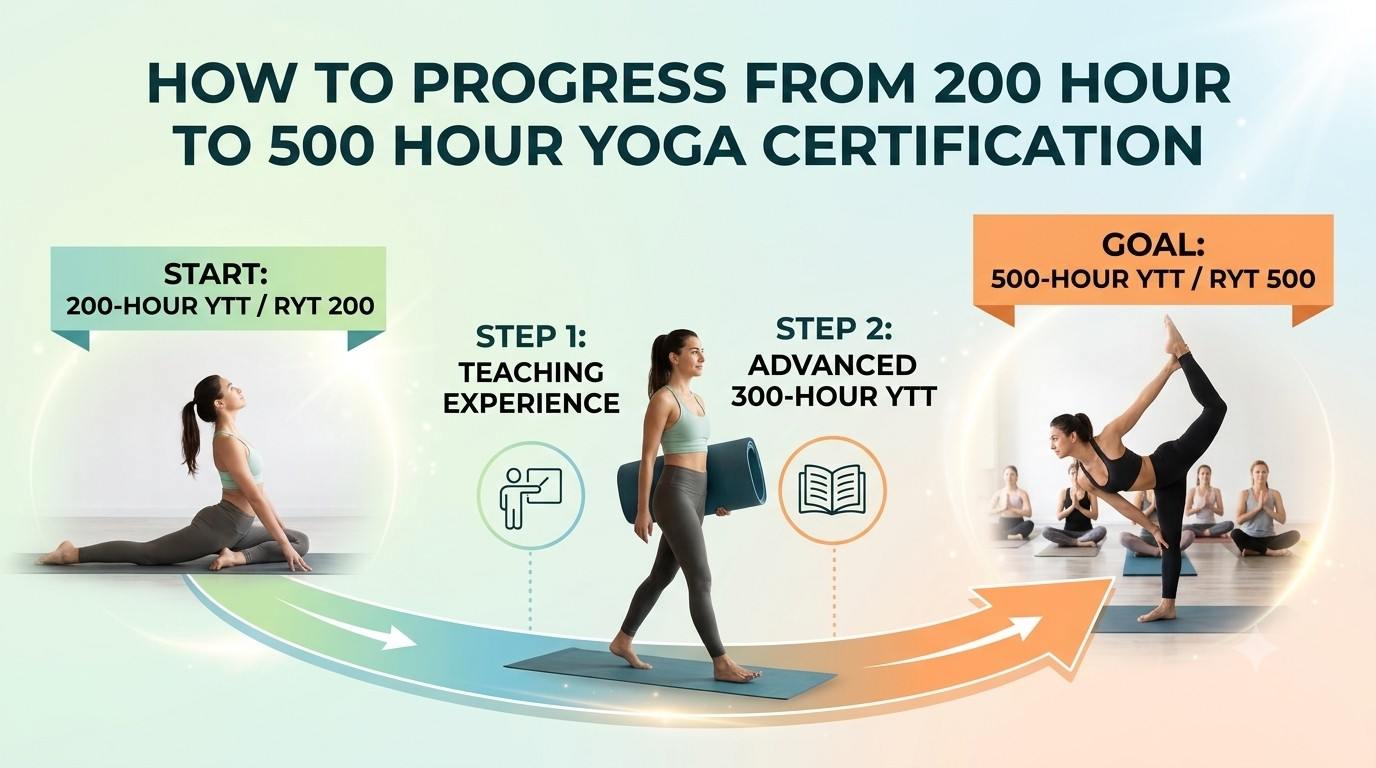
If you want to progress from your 200-hour course to a 500-hour certification, the usual approach is to take the 200-hour course and then another 300-hour advanced course. To become certified in RYT 500 by Yoga Alliance, you can complete a total of 500 hours of training either in one 500-hour course or in a combination of 200 hours and 300 hours across two registered courses. The teaching requirement of a minimum of 100 hours is also necessary to become RYT 500 certified.
After completing the 200-hour yoga training course, your next logical step would be to move on to the advanced course.
What Is the Path From 200 Hour to 500 Hour Yoga Teacher Training?
The transition from 200-hour to 500-hour yoga teacher training is a highly sophisticated route for educators wishing to acquire profound knowledge, develop teaching skills, and gain experience.
The path may be represented in such a way:
200-Hour Foundation → 300-Hour Advanced Training → 500-Hour Total Training
While the 200-hour course creates the foundation of teaching, the 300-hour yoga teacher training is focused on advancing teaching skills and knowledge.
Yoga Alliance supports the RYT 500 pathway via a 500-hour yoga teacher training program or via a combination of a 200-hour yoga teacher training program and additional 300-hour yoga teacher training.
The progression at a glance
What Does a 200-Hour Yoga Teacher Training Provide?
A 200 hour yoga teacher training certification is normally considered the foundation of professional training.
It will assist the students in gaining knowledge of the following:
Yoga techniques and practices
Teaching methodology
Sequencing
Anatomy and physiology
Yoga philosophy
Meditation
Pranayama
Professional ethics
Practical teaching skills
However, the aim here is not just to gain 200 hours. A good foundational course should equip you with the ability to practice safely and also be able to convey information to the students effectively.
According to Yoga Alliance, RYT 200 is the foundational certification for those who have undergone the 200-hour training program from Yoga Alliance.
What Should You Do After 200 Hour Yoga Teacher Training?
Once you complete a 200-hour course, you will be ready to concentrate on your teaching career, get practice and choose your specialization.
In choosing an advanced course, you need to consider:
Who do I want to teach?
What styles of yoga appeal to me?
Do I want to teach group lessons or provide individual instruction? Do I wish to organize retreats or workshops?
What are the things that need to be improved in my teaching?
Do I require additional information about anatomy and philosophy?
Is it interesting to me to become an experienced and specialized teacher?
This personal reflection will help you choose a suitable course.
It is not obligatory for you to take the next step immediately. Many teachers find it helpful to get some practical experience after completing the basic course.
What Is a 300-Hour Yoga Teacher Training?
A 300 hour yoga teacher training is advanced training that is based on prior foundational education.
As opposed to making the 300-hour training into another introductory program, it is best if students opt for a program that builds on their knowledge and hones their teaching skills at a more advanced level.
Depending on what a particular school offers, an advanced program could cover such topics as:
Advanced Asana Practice
Advanced Sequencing
Teaching Methodology
Anatomy & Physiology
Philosophy & Humanities
Meditation & Pranayama
Adjustments & Modifications
Special Populations
Teaching Practicum
Professional Development
Personal Practice
According to Yoga Alliance, RYS 300 Programs are Advanced Programs building on Foundations of Teaching Knowledge and developing Teaching Techniques, Philosophy, Anatomy, Sequencing, Specialized Teaching, etc.
How Does 300-Hour Training Complete the 500-Hour Pathway?
Whereas, if you are already certified by the qualifying 200-hour training, then the 300-hour training will increase your total number of training hours to 500 hours.
200 hours + 300 hours = 500 hours
For the case of Yoga Alliance's RYT 500 program, the 200-hour and the 300-hour training may be undertaken in one or two institutions. All this provided the schools are accredited with the required RYS status.
It just means that you do not need to complete the 500 hours of training in one school.
Nevertheless, it is important to find out whether the institution is registered or not before undertaking any training.
Can You Go Directly From 200 Hour to 500 Hour Yoga Certification?
That is true, but there is a very crucial point.
It is possible to move from 200-hour training to 500-hour training by fulfilling the additional 300 hours needed in the case of composite training. On the other hand, one could opt for a full 500-hour training, in which the training curriculum should conform to 500-hour standards.
As far as obtaining Yoga Alliance RYT 500 certification, two accepted types of training would allow a person to get it:
500-hour yoga teacher training certified by Yoga Alliance, or
200-hour training followed by 300-hour advanced training at appropriately registered schools.
Hence, a person with a 200-hour certificate would look for 300-hour advanced yoga teacher training.
What Is the Difference Between 200 Hour and 500 Hour Yoga Teacher Training?
It all comes down to the level and progression of your education.
With a 200-hour course, you get your basic education, which allows you to start forming as a teacher. With 500 hours, you can continue this education with additional training and experience.
The 500-hour designation should not be viewed simply as "more hours." The quality and relevance of the additional training matter.
What Is RYT 500 Certification?
The letters “RYT 500” refer to the Registered Yoga Teacher 500 and denote the teacher certification provided by Yoga Alliance.
From the standards formulated by Yoga Alliance, we understand that, in its current standards, the requirements of the training program can be met by either participating in a 500-hour teacher training program in RYS 500 or by completing RYS 200 and then an additional 300 hours in RYS 300 and RYS 500 programs and completing 100 hours of teaching practice.
What is important to note is that participating in a 500-hour teacher training program and becoming RYT 500 can be viewed as two different things. The registration process includes the completion of the credentialing requirements and submission of the needed documents.
Another requirement is set by Yoga Alliance and indicates that all certificates of teacher training for RYT registration must include certain information, which includes the name of the registered school, training designation, date of completion, legal name of the trainee, and the authorized signature.
How Many Teaching Hours Are Required for RYT 500?
For the current Yoga Alliance RYT 500 pathway, applicants must have at least 100 hours of teaching experience after completing training with an RYS 200 or RYS 500.
This is an important part of the progression because advanced teacher education is not only about classroom learning.
Teaching real students can help you develop:
Clear communication
Class management
Sequencing confidence
Observation skills
Adaptability
Student interaction
Professional teaching habits
The combination of training and practical teaching experience can create a stronger foundation for long-term development.
How to Choose a 500 Hour Yoga Teacher Training in India
If you are considering a 500-hour yoga teacher training India, do not choose a program based only on the number of hours.
Evaluate the school and curriculum carefully.
1. Check the school's credentials
If Yoga Alliance registration is important to you, verify the school's current RYS designation through Yoga Alliance's directory.
Yoga Alliance provides a directory where users can search registered schools by designations such as RYS 200, RYS 300, and RYS 500.
2. Review the curriculum
Look beyond the course title.
Check whether the program includes the subjects you actually want to study, such as advanced sequencing, anatomy, philosophy, meditation, pranayama, teaching methodology, or specialized instruction.
3. Research the teachers
Look for instructors with relevant training, teaching experience, and a clear professional background.
4. Check practical teaching opportunities
A strong advanced program should provide opportunities to practice teaching and receive meaningful feedback.
5. Understand what the certificate represents
Before enrolling, ask exactly what certificate you will receive and whether it is intended to meet the requirements of the credential you want to pursue.
Why Consider 500 Hour Yoga Teacher Training in Rishikesh?
A 500-hour Yoga Teacher Training Course in Rishikesh could be the right way to go for those teachers who want to get higher education in terms of yoga in the traditional sense.
This town is famous for its connections to yoga, meditation, spiritual education and yoga teacher training. Training in this town could be seen as an opportunity to get deeper knowledge of yoga from both textbook and life experiences.
However, for Yoga teacher training in india international students this factor of place of training is not the only one that matters.
Consider:
Curriculum quality
Instructors' experience
School reputation
Group size
Practice teaching
Accommodations
Class schedule
Course duration
Other students' reviews
Requirements for certification
A proper program will fit you better than offering many hours of training.
Is Advanced Yoga Teacher Training Worth It?
Advanced yoga teacher training can be worthwhile if you have a clear reason for continuing your education.
It may be particularly useful if you want to:
Strengthen your teaching methodology
Improve sequencing skills
Deepen your personal practice
Study yoga philosophy in greater depth
Develop expertise in specific areas
Teach more confidently
Expand your professional opportunities
Prepare for advanced teaching roles
However, a 500-hour course is not automatically better simply because it has more hours.
The value comes from what you learn, how you practice, who teaches you, and how effectively you apply the knowledge.
200 Hour to 500 Hour Yoga Teacher Training: A Practical Roadmap
If you are planning your progression, the following roadmap can help.
Step 1: Complete your 200-hour training
Build your foundation through a recognized and appropriately structured program.
Step 2: Start teaching
Use your knowledge in real classes and begin developing your own teaching voice.
Step 3: Identify your learning gaps
Think about where you need deeper knowledge.
For example:
Anatomy
Sequencing
Philosophy
Meditation
Pranayama
Adjustments
Teaching methodology
Step 4: Research 300-hour programs
Compare schools, curriculum, teachers, practical training, location, duration, fees, and credentialing implications.
Step 5: Complete advanced training
Undertake the additional 300 hours that fit your chosen pathway.
Step 6: Continue teaching
Build practical experience while applying what you learned during advanced training.
Step 7: Verify your credential requirements
If you are pursuing RYT 500, check the latest Yoga Alliance requirements before submitting your application.
Step 8: Continue professional development
Your education does not have to stop at 500 hours. Experienced teachers can continue studying through additional training, continuing education, workshops, and specialized programs.
How Long Does It Take to Progress From 200 to 500 Hours?
A timeline is not applicable to everyone.
In your personal case, there could be some factors affecting your timeline, such as:
If you attend classes on a full-time or part-time basis
Duration of the 300-hour program
Schedule of your institute
Teaching responsibilities
Travelling required
Personal commitments
Some students begin their advanced training just after their 200-hour program, while others wait for months or even years before they can continue further.
The ideal timeline would be one that provides you with ample time to digest everything.
What Should You Look for in a 300-Hour Advanced Training?
Before enrolling, use this checklist: Curriculum Does it genuinely build on 200-hour knowledge? Does it include advanced teaching methodology? Does it provide enough practical teaching? Teachers Are instructors experienced? Are their credentials and professional backgrounds clearly presented? School Is the school's registration status verifiable if that matters to you? Does the school provide clear information about certification? Learning environment Is there enough individual feedback? Are class sizes appropriate? Is the schedule realistic? Student experience Are reviews consistent? Are accommodation and meals clearly explained? Are policies transparent? Career relevance Will the training help you develop the skills you actually want?
Frequently Asked Questions
Yes. A 300-hour advanced training is a common progression after foundational 200-hour training. For the Yoga Alliance RYT 500 pathway, an additional 300 hours can be combined with qualifying 200-hour training to meet the 500-hour training requirement. Yes, the 200-hour plus 300-hour pathway can satisfy the training requirement for RYT 500 when the programs meet the applicable Yoga Alliance requirements. You must also meet the teaching-hour and other registration requirements. Not necessarily. Yoga Alliance states that the 200-hour and 300-hour programs may be completed at different schools if each has the appropriate active RYS designation. Generally, a 500-hour pathway is intended as a more advanced educational route. If you are completely new to teaching, beginning with a foundational 200-hour program is usually the more appropriate starting point. RYT 200 is based on completing a qualifying 200-hour teacher training, while RYT 500 represents completion of the required 500 hours of training through an eligible pathway and fulfillment of the applicable teaching and registration requirements. Not automatically. A school certificate documents completion of training, while RYT 500 is a specific Yoga Alliance credential with its own requirements. Always verify what a particular school's certificate qualifies you for before enrolling. Yes, Rishikesh offers yoga teacher training programs at different levels. If your goal is a specific credential such as RYT 500, verify the school's current registration status and whether the program meets the applicable credential requirements before enrolling.Can I do a 300-hour yoga teacher training after 200 hours?
Can I get RYT 500 after completing 200 and 300 hours?
Do I need to complete 500 hours at the same yoga school?
Is 500-hour yoga teacher training suitable for beginners?
What is the difference between RYT 200 and RYT 500?
Is 500-hour yoga certification the same as RYT 500?
Can I complete my 500-hour yoga training in Rishikesh?
Final Thoughts
Moving from 200 Hour to 500 Hour Yoga Teacher Training involves much more than just adding extra training hours to your training credentials. This is where you can get a chance to build up your expertise and experience in your craft.
Most likely, the best way for any teacher will be the following sequence:
Do 200 hours → Teach & gain experience → Do 300 hours of advanced training → Accumulate 500 hours of training → Qualify for RYT 500 requirements.
When thinking about 500-hour yoga teacher training in Rishikesh, India, take time to review different schools and compare them to each other.
Most importantly, choose advanced training because it supports your development as a teacher—not simply because the certificate says "500 hours.