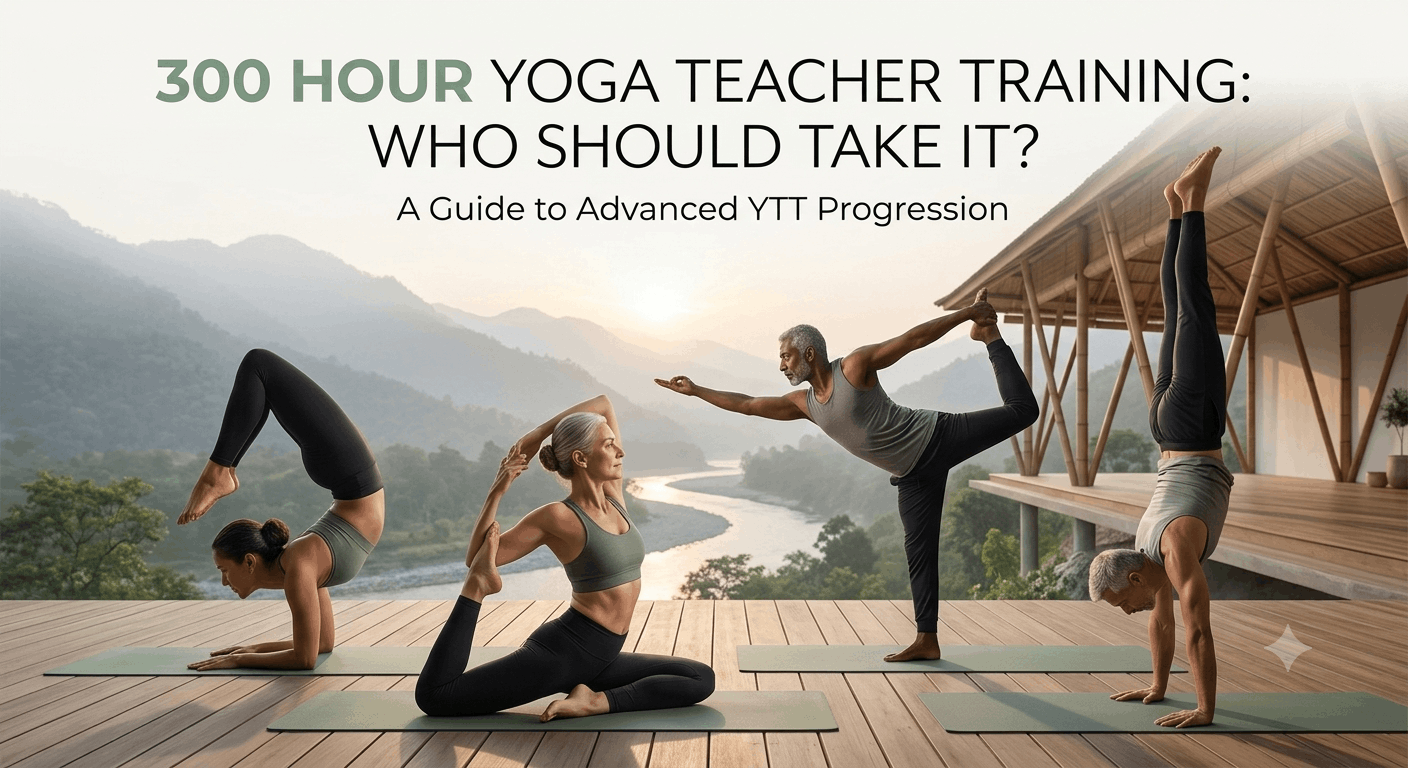
A 300-Hour Yoga Teacher Training course is generally designed for yoga teachers and experienced practitioners who already have a strong foundation in yoga and want to deepen their knowledge, teaching skills, and professional development. It can be a good next step for those seeking advanced study, specialization, or a deeper understanding of yoga.
Select the 300-hour: A 300-hour training takes time, dedication, and a deep interest in growth. It isn't necessarily where someone brand new to yoga, or a first-time trainee, should start.
This guide explains who should consider a 300-hour course, who may want to wait, what you can learn, how it compares with 200-hour training, and what to look for before enrolling.
300-Hour Yoga Teacher Training at a Glance
What Is a 300 Hour Yoga Teacher Training Course?
A 300 hour yoga teacher training course A 300 hour yoga teacher training course is an in-depth program of study to pursue further in your training and in the life of yoga after starting your practice a few years prior. It also provides a curriculum of training in areas of yoga, including teaching technique, anatomy, the philosophy of yoga, pranayama and the philosophy of meditation, as well as some particularities of practice.
The number of 300-hour yoga training gives the quality of what a teacher training course offers, but the education given at each one differs quite a bit, and so do the admission requirements.
What Does “300 Hours” Mean?
300-hours means the amount of time that has been spent in training in this specific program. This could be, but not limited to, classroom learning, hands-on practice, practising teaching and extra studies, depending on the specific program of study. More hours of teaching do not signify better teaching.
Teachers' qualifications, quality of the course contents, quality of practical application as well as environment and facilities for studies play an equally big role.
Is a 300-Hour YTT the Same as a 300-Hour Yoga Course?
Not necessarily.
A 300 hour YTT will typically be structured to train you as an instructor or develop a teacher and may have a very different structure to a 300-hour practitioner workshop series or continuing education course.
Make sure you ascertain if it’s designed as a teacher training before you sign up, what credential it provides, and if it aligns with what will be required by a particular organization or registration process you aspire to join.
What Is RYT 300 Certification?
The term RYT 300 should be understood carefully. Completing a course and receiving a course certificate is not automatically the same thing as obtaining professional registration with a credentialing organization.
If you are considering a program because of RYT 300 certification, verify the current requirements directly with the relevant organization and confirm that the specific training you choose satisfies those requirements.
Who Should Take a 300 Hour Yoga Teacher Training?
A 300-hour course can be a suitable choice for people who already have foundational knowledge and want to continue their education. It is particularly relevant to existing yoga teachers, experienced practitioners and students with clear professional or educational goals.
Here are some of the people who may benefit most from advanced training.
1. Yoga Teachers Who Already Have Foundational Training
Yoga instructors who are already teaching are a natural fit for further training. For example, after you have experienced teaching basics for a while you might want a deeper dive into sequencing, communication, anatomy, philosophy, observation and methodology.
It is possible to get to use the concepts you were exposed to in a base training course on a more advanced level and use a 300 hour course in order to get very comfortable using basics in new environments.
2. Experienced Yoga Practitioners Who Want Deeper Knowledge
Youdon’thavetoteachyogaallthetime to takeworkshops The experienced practitioner mighthavethirtyhourtrain to learn yoga other than fromaphysicalpracticeperspective. Depending on the program's curriculum,such studies could deeply delve, specialize and expand in the fields of,anatomy,subtly-body topics or in short,yoga- beyondtheAsanas. If your practice has become a vital part of your daily life and site to love with a deeper intention,such training is surely something to consider.
3. Teachers Who Want to Develop a Specialization
Another reason to consider advanced training is specialization.
Different schools offer different areas of focus. A program may emphasize subjects such as:
Advanced asana
Yoga philosophy
Meditation
Pranayama
Anatomy
Alignment
Sequencing
Restorative practices
Therapeutic approaches
Teaching methodology
However, these subjects are not included in every program. Always examine the curriculum to make sure it matches your specific goals.
4. Yoga Teachers Who Want to Improve Their Teaching Skills
Teaching yoga is more than demonstrating postures.
An experienced instructor may want to improve:
Verbal cueing
Class sequencing
Lesson planning
Observation skills
Teaching methodology
Student communication
Adaptation of practices
Giving appropriate feedback
Creating classes for different experience levels
Advanced teacher training can give teachers more opportunities to practice these skills and receive feedback.
5. Teachers Building a Long-Term Yoga Career
A 300-hour program may also appeal to teachers who want to continue developing professionally.
Advanced education can support teachers who are interested in areas such as:
Yoga studios
Private classes
Retreat teaching
Workshops
Specialized classes
Further academic or professional study
However, completing a course does not guarantee employment, clients or income. Your professional success will also depend on teaching ability, experience, communication, networking, business skills and the needs of your target market.
6. Practitioners Considering Yoga as a Long-Term Career
Some students ultimately find they'd like to weave yoga into their work more prominently. To them, advanced yoga teacher training offers the chance to deepen their understanding and deepen the aspects of the field you can see yourself integrating into a career path.
Before you register, take a close look at how the curriculum stacks up against your professional aspirations.
7. Students Looking for Immersive Study in India
Those interested in gaining an intensive cultural and educational experience in yoga might consider the 300-hour yoga teacher training programs in India. There are dozens of yoga training schools, programs and styles from which to choose and it is beneficial to compare them.
The residential yoga teacher training option can be ideal for individuals eager for traditional study in a deeply immersive environment blending formal study with abundant opportunities to practice, practice, practice with students and instructors.
Who Should Not Take a 300 Hour Yoga Teacher Training Yet?
Advanced training is not automatically the best choice for everyone.
Sometimes the best decision is to build a stronger foundation first.
Complete Beginners With No Yoga Foundation
If you are completely new to yoga, an advanced program may not be the most appropriate starting point.
A foundational course can give you time to understand basic postures, breathing practices, anatomy, philosophy and teaching principles before moving into more advanced material.
Students Without Consistent Practice
Advanced education requires commitment.
If your yoga practice is still very occasional, you may benefit from developing consistency before investing in intensive teacher training.
Building a regular practice can help you understand your own body, limitations and learning style.
People Choosing a Course Only for a Certificate
Don't let the certification be the only reason for committing to 300 hours of training. To get a good training program experience you have to work and really love to learn.
So look at the course, teachers, practical training, and support structure and your personal objectives before looking at the certificate itself.
Anyone Expecting Guaranteed Career Success
No training course can guarantee a successful yoga career.
A qualification can contribute to your education and professional development, but building a career also requires practical experience, communication skills, business knowledge and continued learning.
Students Mainly Looking for Fitness
If your main goal is simply exercise, flexibility or general wellness, a 300-hour teacher training course may be more intensive than necessary.
Do You Need a 200 Hour YTT Before a 300 Hour YTT?
This is one of the most important questions to ask before enrolling.
Is a 200-Hour YTT a Prerequisite?
The answer depends on the specific program and its admission requirements.
Many advanced programs are structured for students who have already completed foundational teacher training or have relevant experience. However, requirements can vary by school, program and credentialing pathway.
Therefore, never assume that every 300 hour yoga training course has identical entry requirements.
Check the school's official admission information before registering.
Why Is 200-Hour Training Considered Foundational?
A 200-hour program typically introduces students to core areas of yoga education.
Depending on the school, these may include:
Foundational asana
Basic anatomy
Pranayama
Meditation
Yoga philosophy
Teaching methodology
Sequencing
Practice teaching
A 300-hour program can then allow students to explore some of these areas in greater depth.
Can an Experienced Practitioner Enrol Directly?
A few programmes will offer alternative entry criteria to experienced practitioners. On the flip side, some schools will ask for proof that you have completed teacher training prior to their programme. What is important is that you look at the requirements of the individual school that you are wishing to study at, not general recommendations. If you have plenty of experience but do not have a 200hr certification, then get in touch with the school or training organisation and ask.
What Do You Learn in a 300 Hour Yoga Teacher Training?
The curriculum differs from one school to another, but advanced training may explore a range of subjects in greater depth.
The word “may” is important here. A 300-hour program is not required to teach every subject listed above. Always compare the actual syllabus before choosing a course.
200 Hour vs 300 Hour Yoga Teacher Training: Which Is Best?
200 Hour vs 300 Hour Yoga Teacher Training - The right program depends on your current experience and goals.
Which One Should You Choose?
The 200-hour program is suitable if you are completely new to formal teacher training and want to gain experience and have a starting point for your training.
The 300-hour program is most suitable if you already have adequate grounding and teaching experience and want to refine your teaching or create a specialisation.
It depends entirely on your level at the present and the aspirations that you have when it comes to formal teacher training.
What Are the Benefits of a 300 Hour Yoga Teacher Training?
A well-designed advanced program can provide several educational and professional benefits.
Deeper Understanding of Yoga
Advanced study gives students more time to explore concepts that may only receive introductory attention in foundational training.
Greater Confidence as a Teacher
More practice, observation and feedback can help teachers become more comfortable planning and delivering classes.
Better Sequencing and Class Planning
Advanced study may help instructors develop more thoughtful sequences based on student needs, class objectives and teaching context.
Opportunity to Specialize
A focused curriculum can allow students to explore a specific area of interest in greater detail.
Continued Professional Development
Teachers can continue learning instead of treating their initial qualification as the end of their education.
Deeper Study of Philosophy and Traditional Practices
For students interested in yoga beyond physical practice, advanced training may provide more time for philosophical and contemplative study.
Personal Growth
Immersive training can also encourage students to reflect on their practice, habits, teaching approach and understanding of yoga.
Is a 300 Hour Yoga Teacher Training Worth It?
Whether a 300-hour program is worth the investment depends on your goals.
It may be worth considering if:
You already have a strong yoga foundation.
You are currently teaching yoga.
You want to improve your teaching skills.
You want to specialize in a particular area.
You enjoy deeper philosophical study.
You want continued professional education.
You have found a curriculum that matches your goals.
The teachers have relevant qualifications and experience.
It may not be the right investment if:
You are completely new to yoga.
You only want exercise or general wellness.
You are choosing the program solely for its certificate.
You are not ready for intensive study.
The curriculum does not match your interests.
The school's certification claims are unclear.
The goal should be to choose education that provides genuine value rather than simply collecting another qualification.
How to Choose the Right 300 Hour Yoga Teacher Training Course
Choosing a school is just as important as deciding to take advanced training.
Check the Curriculum
Look for a clearly documented curriculum.
Ask:
What subjects are included?
How much practical teaching is provided?
Is there a specialization?
How are students assessed?
Is there supervised teaching practice?
How much independent study is expected?
Research the Teachers
Look at the instructors' actual qualifications and professional experience.
Consider their:
Training background
Teaching experience
Areas of specialization
Professional history
Approach to education
Avoid relying only on impressive marketing language.
Verify Certification Claims
Be particularly careful with statements such as “internationally recognized.”
Ask exactly:
What certificate will I receive?
Who issues it?
Is the course registered or affiliated with a specific organization?
What requirements must I meet?
Does completing this course qualify me for the registration pathway I am interested in?
Always verify current requirements with the relevant organization.
Check the Course Format and Duration
Different students have different needs.
Programs may be:
Residential
In-person
Online
Hybrid
Intensive
Extended-format
Think about your schedule, preferred learning environment and ability to commit to the course.
Read Independent Reviews
Testimonials on a school's own website can be useful, but they should not be your only source of information.
Look for independent reviews and try to understand both the strengths and limitations of the program.
Understand What the Fees Include
Before paying, confirm what is included.
Depending on the school, fees may or may not include:
Tuition
Accommodation
Meals
Study materials
Assessment
Certification
Transportation
Excursions or additional activities
Ask for a complete fee breakdown before making a decision.
300 Hour Yoga Teacher Training in Rishikesh
A 300 Hour Yoga Teacher Training in Rishikesh is often chosen by Students who would like to expand their knowledge of yoga while immersing themselves in the authentic Indian context. Rishikesh itself is largely known in the yoga world as a centre for yoga schools and brings students in from around the globe; however, we don’t advise learning at a yoga school simply because of its proximity to the Himalayas.
Quality of training comes from more than location and curriculum content; it is down to the teacher, methodology, student services and the learning environment.
Why Consider Rishikesh for Advanced Training?
Students may choose Rishikesh because they want:
An immersive learning environment
Exposure to traditional yoga practices
Deeper study of yoga philosophy
A residential experience
Interaction with teachers and international students
The opportunity to study yoga in India
These are potential advantages, not guarantees. Every school provides a different experience.
What Should You Check Before Choosing a Yoga School in Rishikesh?
Before enrolling in a 300 hour yoga teacher training India program, compare:
Course curriculum
Teacher qualifications
Practical teaching hours
Student reviews
Accommodation
Class size
Certification details
Prerequisites
Fees and inclusions
Refund and cancellation policies
Health and safety arrangements
Exact course location
Do not choose a program simply because it uses phrases such as “best,” “international,” or “recognized.” Look at the evidence behind those claims.
How to Prepare for a 300 Hour Yoga Teacher Training
Good preparation can make intensive study more productive.
Strengthen Your Personal Practice
Develop a consistent practice before beginning the course. You do not need to practice perfectly, but regularity can help you adjust to intensive training.
Review Foundational Anatomy
Refreshing basic anatomy can make more advanced discussions easier to understand.
Revisit Yoga Philosophy
If your previous training introduced yoga philosophy, revisit the core concepts before starting advanced study.
Practice Teaching
If you already teach, reflect on your current teaching style.
Ask yourself:
What are my strengths?
Where do students struggle?
How can I improve my cueing?
How comfortable am I with sequencing?
What feedback have I received?
Define Your Learning Goals
Know why you want to take the course.
Your goal might be:
Becoming a more skilled teacher
Studying philosophy
Developing a specialization
Improving sequencing
Deepening your personal practice
Continuing professional education
Clear goals make it easier to select the right program.
Prepare Physically and Mentally
A 300-hour course can involve intensive study and practice. Prepare yourself for a structured learning environment and give yourself enough time to rest, study and recover.
Questions to Ask Before Enrolling in a 300 Hour YTT
Before making a payment, ask the school:
What are the prerequisites?
Who teaches the program?
What qualifications do the teachers have?
What is the complete curriculum?
How much practical teaching is included?
What certification will I receive?
Is the program associated with a specific credentialing organization?
What are the assessment requirements?
How many students are in each group?
What is included in the course fee?
What accommodation options are available?
What is the cancellation and refund policy?
Is there support after graduation?
Can previous education or experience meet any admission requirements?
Getting clear answers before enrolling can prevent misunderstandings later.
Frequently Asked Questions
What is a 300 Hour Yoga Teacher Training?
A 300-hour yoga teacher training is an advanced education program that provides additional study beyond foundational yoga teacher training. Depending on the school, it may cover advanced teaching methodology, anatomy, philosophy, pranayama, meditation, sequencing and specialized subjects.
Who should take a 300-hour yoga teacher training?
A 300-hour program is generally best suited to experienced yoga practitioners and existing teachers who have an appropriate foundation and want to deepen their knowledge, improve teaching skills or explore a specialization.
Is 300-hour yoga teacher training suitable for beginners?
Usually, a foundational teacher training is more appropriate for someone who is completely new to yoga education. However, admission requirements differ between programs, so students should check the specific school's criteria.
Do I need a 200-hour YTT before taking a 300-hour YTT?
It depends on the program. Many advanced courses are designed for students with previous foundational training, while specific admission pathways can vary. Always check the school's current prerequisites before enrolling.
What is the difference between 200-hour and 300-hour yoga teacher training?
A 200-hour program is generally foundational, while a 300-hour program is generally more advanced. The 200-hour level commonly establishes core teaching knowledge, whereas advanced training can provide deeper study, specialization and continued professional development.
What does RYT 300 mean?
RYT 300 refers to a professional registration designation used within a particular credentialing framework. A course certificate and professional registration are not necessarily the same thing. Check the current requirements of the relevant credentialing organization.
How long does a 300-hour yoga teacher training take?
The duration depends on the school's schedule and delivery format. Some programs are intensive residential courses, while others are spread over a longer period. Check the exact schedule before enrolling.
What do you learn in a 300-hour yoga course?
The curriculum varies, but advanced courses may include deeper study of asana, anatomy, teaching methodology, philosophy, pranayama, meditation, sequencing and specialization. Always review the specific syllabus.
Is a 300-hour yoga teacher training worth it?
It can be worthwhile for experienced practitioners and teachers who have clear learning goals and choose a high-quality program that matches those goals. It may be unnecessary for beginners or people seeking only general fitness.
Can I take a 300-hour yoga teacher training in India?
Yes, India offers a wide range of advanced teacher training programs. If you choose to study in India, compare the school's curriculum, teachers, prerequisites, accommodation, fees and certification claims before enrolling.
Can a 300-hour YTT help me become a better yoga teacher?
Advanced training can help teachers develop their knowledge, teaching methodology, sequencing, communication and specialization. However, improvement also depends on consistent practice, teaching experience, feedback and continued learning.
What should I look for in an advanced yoga teacher training?
Look for a transparent curriculum, qualified teachers, appropriate prerequisites, practical teaching opportunities, clear certification information, reasonable student support and independent reviews. Choose a program based on educational quality rather than marketing claims alone.
Is a 300 Hour Yoga Teacher Training Right for You?
A 300 Hour Yoga Teacher Training may be the right next step if you already have a strong foundation in yoga, meet the program's prerequisites and want to deepen your teaching knowledge, personal practice or specialization. You may be ready if: You have a consistent yoga practice. You have completed appropriate foundational training or meet the school's experience requirements. You are interested in advanced study. You want to improve your teaching skills. You have a clear reason for pursuing advanced training. You are prepared for intensive learning. You have researched the school and its instructors. The curriculum matches your goals. If you are completely new to yoga teacher training, there is no need to rush into an advanced program. A strong foundation can give you the knowledge and experience needed to benefit more fully from advanced study later. Ultimately, the best 300 hour yoga training is not simply the one with the most attractive website or the biggest list of promises. It is the program whose curriculum, teachers, learning environment, prerequisites and certification pathway genuinely match your needs. Whether you choose to study locally or pursue 300 hour yoga teacher training in Rishikesh, take time to research your options and make an informed decision. Advanced education is most valuable when you approach it with curiosity, commitment and a clear understanding of what you want to learn.