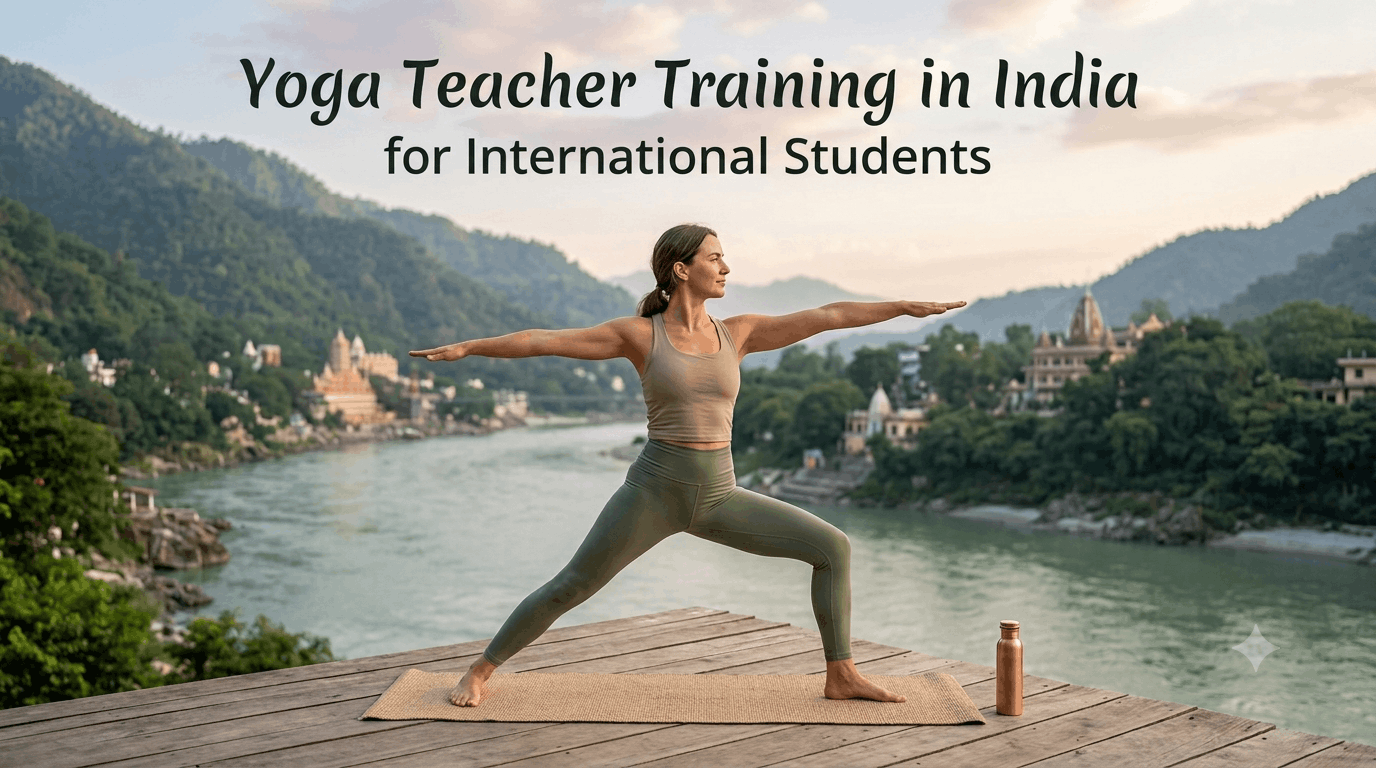
A 200-hour yoga teacher training in India is generally the starting point for students who want foundational teacher education. If you want to pursue the Yoga Alliance RYT 200 credential, choose a 200-hour program registered with a Yoga Alliance Registered Yoga School (RYS 200) and follow Yoga Alliance's current registration requirements.
India is an ideal destination for aspiring international students to pursue a Yoga Teacher Training program. By studying in its traditional cultural background, one can gain comprehensive knowledge and hands-on experience to become a well-trained Yoga instructor. Training centres in India offer various residential yoga teacher training courses from basic 200 hr to advanced, Rishikesh being one of the prime locations.
While selecting a yoga teacher training program in India as an international student, consider the course structure, teaching practice, school certifications, lodging, budget, visa, batch size, and the certification provided.
Key Takeaways
India offers residential yoga teacher training for students from around the world. Rishikesh is a major destination for international yoga students. A 200-hour yoga teacher training in India is a common starting point for aspiring teachers. Yoga Alliance's RYT 200 credential is associated with completing a qualifying 200-hour training at an RYS 200. Course fees vary according to the school, course length, accommodation, meals, facilities, and inclusions. International students should verify visa requirements before booking a formal course. A yoga teacher training certificate does not automatically guarantee employment or a specific salary. Choosing a school based only on price can result in missing important factors such as teaching practice, faculty experience, safety, and accreditation.
Table of Contents
What Is Yoga Teacher Training in India?
Yoga Teacher Training in India is a course structure designed to deepen your knowledge of your yoga practice, teaching methods, anatomy, philosophy, meditation, pranayama, and practical teaching. The syllabus can vary a little from school to school, and an appropriate course should focus not only on the mechanics of performing poses, but also on safe application and the ability to convey the philosophy.
For foreign students, residential training can be an ideal place where study, practice and living are blended in one place.
What Does a Yoga Teacher Training Course Usually Include?
Depending on the program, students may study:
Asana practice
Pranayama
Meditation
Yoga anatomy and physiology
Yoga philosophy
Teaching methodology
Sequencing
Alignment and modifications
Teaching practicum
Sanskrit terminology
Yogic lifestyle
Ethics and professional responsibilities
Self-practice and observation
Yoga Alliance's RYS 200 framework, for example, organises foundational training around areas including Techniques, Training & Practice; Anatomy & Physiology; Yoga Humanities; and Professional Essentials.
Why Choose India for Yoga Teacher Training?
India can be an attractive destination for students who want to experience yoga in a country with a long-standing yoga tradition.
The main advantage is not simply the location. The quality of your experience depends heavily on the school, faculty, curriculum, accommodation, student support, and amount of supervised teaching practice.
Why International Students Choose India
International students may choose India because they want:
An immersive residential learning experience
Exposure to traditional yoga philosophy
Daily structured practice
Direct interaction with experienced teachers
A multicultural student community
Opportunities to explore different yoga traditions
Training in established yoga destinations such as Rishikesh
India is particularly appealing if your goal is to combine teacher education with cultural immersion rather than simply complete an online qualification.
Why Is Rishikesh Popular for International Students?
Rishikesh is a highly popular yoga teacher training destination within India, most famously for those travelling from abroad.
The city itself possesses extensive yoga infrastructure that includes countless schools, ashrams, centers, teachers and wellness centers and courses in many varied styles and formats. This ranges from short introductory workshops to extensive teacher training courses.
A Rishikesh based yoga school can also present a residentially based course in which all students will stay, dine, practice and attend classes together for the duration of their course.
However, the position the yoga schools occupy should not be the only determining factor. Indeed, even two teaching schools on the same road can present extremely different learning experiences, facilities and schedules for their students.
What Should You Check in a Rishikesh Yoga School?
Before booking, compare:
School credentials
Curriculum
Faculty qualifications and experience
Number of students per batch
Daily schedule
Teaching practicum
Accommodation
Meals
Course duration
Certificate details
Student reviews
Refund and cancellation policy
Visa guidance
Airport or local transportation support
Yoga Alliance maintains a school directory where students can check registered yoga schools and their designations.
How Much Does Yoga Teacher Training Cost in India?
The yoga teacher training in India cost varies considerably because schools offer different course lengths, accommodation standards, locations, facilities, and inclusions.
Instead of comparing only the headline fee, international students should calculate the total cost of training in India.
What Can Affect the Course Price?
The final cost may depend on:
For example, AYM Yoga School currently publishes different fees for its 200-, 300- and 500-hour programs depending on accommodation type. Students should always verify the latest fee, inclusions and exclusions directly with the school before making a booking.
Is Affordable Yoga Teacher Training in India Possible?
Yes. India has programs at different price points, but affordable does not automatically mean better value.
When comparing an affordable yoga teacher training India program, check what is actually included.
A lower advertised price may exclude:
Accommodation
Meals
Airport transfers
Course materials
Excursions
Certification or examination fees
Additional workshops
The better question is:
“What do I receive for the total amount I will pay?'
Which Is the Best Yoga Teacher Training Course in India?
There is no single best yoga teacher training in India for every student.
The best program depends on your experience, preferred yoga style, career goals, budget, desired location, accommodation requirements, and certification goals.
A Good Yoga Teacher Training Course Should Offer
Look for a program that provides:
A clearly published curriculum
Experienced instructors
Sufficient practical teaching experience
Anatomy and safety education
Philosophy and traditional knowledge
Small or manageable class sizes
Transparent fees
Clear certification information
Appropriate school registration or accreditation
Student support
A professional learning environment
If your objective is an RYT 200 credential, verify that the school and program meet the applicable Yoga Alliance requirements rather than relying solely on phrases such as “international certification.” Yoga Alliance states that RYT 200 requires completion of a 200-hour training with an RYS 200.
Is 200-Hour Yoga Teacher Training Available in India?
Yes. 200-hour yoga teacher training India programs are widely available, including residential programs in Rishikesh.
A 200-hour course is generally considered foundational teacher training. It can introduce students to practice, teaching methodology, anatomy, philosophy and other core areas required to begin developing as yoga teachers.
Yoga Alliance describes RYT 200 as a credential available after completing a 200-hour yoga teacher training registered with Yoga Alliance.
Who Is a 200-Hour Course For?
It may be suitable for:
Beginners with a serious interest in yoga
Experienced practitioners who want teaching skills
International students seeking an immersive experience
Students considering yoga as a career
People interested in personal development and structured study
You do not necessarily need years of advanced practice before beginning a foundational program, but you should check the school's individual eligibility requirements.
What Is RYT 200 Yoga Teacher Training in India?
RYT 200 means Registered Yoga Teacher 200 Hours. It is a Yoga Alliance credential rather than simply the name of a course.
Yoga Alliance states that teachers can obtain the RYT 200 credential after completing a 200-hour yoga teacher training registered with a Yoga Alliance Registered Yoga School.
This distinction is important:
200-hour course ≠ automatically RYT 200.
Before enrolling, confirm:
Is the school currently an RYS 200?
Is the specific program registered under the appropriate designation?
What certificate will you receive?
What steps are required after graduation?
Are there additional Yoga Alliance registration requirements?
Yoga Alliance also specifies requirements for certificates submitted for RYT registration, including the school name, program designation, completion date, trainee's legal name and authorized signature.
How to Become a Certified Yoga Teacher in India
A typical pathway can look like this:
Step 1: Build a Consistent Personal Practice
Before teaching others, develop your own understanding of yoga through regular practice.
Step 2: Choose a Suitable Teacher Training
Select a program based on your goals, preferred style, schedule, budget and desired credential.
Step 3: Complete the Required Training
Participate fully in classes, assignments, practical sessions and teaching assessments.
Step 4: Complete Teaching Practicum
Practical teaching is important because knowing yoga and teaching yoga are different skills.
Step 5: Receive Your Course Certificate
After successfully completing the school's requirements, you should receive the relevant completion certificate.
Step 6: Apply for the Appropriate Credential
If you completed a qualifying Yoga Alliance RYS program and want to pursue RYT registration, follow the current Yoga Alliance registration process.
Step 7: Continue Learning
Teaching development does not end with the first certificate. Experienced teachers can pursue advanced training, continuing education and speciality credentials.
Which Certificate Is Best for Yoga Teachers?
There is no universal certificate that is automatically “best.”
The appropriate credential depends on where you want to work, the students you want to teach, your specialty, and the requirements of the studio, employer or jurisdiction.
For people pursuing Yoga Alliance credentials, common pathways include:
RYT 200
RYT 500
E-RYT 200
E-RYT 500
RCYT for children's yoga
RPYT for prenatal yoga
Yoga Alliance currently describes RYT 200 as foundational training and RYT 500 as advanced training.
Always distinguish between a school's course completion certificate and a professional credential or registration obtained through an external organization.
Can You Become a Yoga Teacher Without a Degree?
In many cases, a university degree is not the primary requirement for entering yoga teacher training.
Yoga teaching is a specialized field in which practical training, knowledge, communication skills, teaching ability and appropriate credentials can be more relevant than having a conventional academic degree.
However, requirements can vary depending on the country, employer, insurance provider, studio and type of teaching you want to do.
If you plan to work internationally, check the requirements of the specific country and employer rather than assuming that one certificate has identical legal or professional status everywhere.
Can You Teach Yoga Without a Certificate?
This is a more complicated question than it appears.
There is a difference between legal permission to teach, professional expectations, employer requirements, and private teaching.
In some locations, there may not be a single government-issued license required for every yoga teacher. However, studios, insurers and clients may expect recognized training or professional credentials.
For safety and professional credibility, completing appropriate teacher training is strongly advisable.
Yoga Alliance also maintains professional standards and a Scope of Practice for its members.
Can I Teach Yoga Without a Qualification?
You should not assume that personal yoga experience is enough to teach others safely.
Teaching requires skills that are different from practising.
A teacher should understand:
Safe alignment
Modifications
Contraindications
Class sequencing
Verbal instruction
Observation
Student communication
Appropriate use of adjustments
Professional boundaries
Scope of practice
A structured teacher training can help develop these skills systematically.
Is 40 Too Old to Become a Yoga Teacher?
It’s still not too late. Being 40 is no longer too old to teach yoga. People from all walks of life enrol in teacher training.
Having the ability and willingness to learn, maintain your physical well-being, follow through, communicate effectively and complete the programme physically would be of more concern.
Previous and career experiences might lend themselves to be very useful to an older student/teacher, as would your personal experience and relationships. Be upfront with regards to past injuries and ailments with the yoga studio when applying.
What Is the Hardest Part of Yoga Teacher Training?
The hardest part depends on the individual student.
Common challenges include:
Intensive Daily Schedule
Residential programs can involve several hours of practice and study each day.
Learning Anatomy
Understanding anatomy requires more than memorizing body parts. You need to connect anatomical principles with movement and safe instruction.
Yoga Philosophy
Traditional texts and philosophical concepts may be unfamiliar to international students.
Teaching in Front of Others
Many students feel nervous when they teach their first class.
Personal Discipline
A structured residential environment requires consistency with practice, study, meals, rest and assignments.
Adapting to a New Culture
International students may need time to adjust to Indian food, climate, customs, language and daily routines.
These challenges are part of what makes teacher training transformational for many students—but a serious program should also provide appropriate support.
Can I Make a Living as a Yoga Teacher?
You can absolutely make an income teaching yoga, but a YTT course alone doesn’t guarantee you employment or a fixed wage.
Yoga teachers can have many different paths in yoga including:
Teaching in studios
Teaching private classes
Teaching online
Teaching retreats
Corporate health and wellbeing
Teaching workshops
Teaching a specialist type of yoga
Assisting training courses
Working in wellness centers
Working with hotels and resorts
Whether you are employed or self-employed it will be based on where you live, experience, niche, clientele base, number of hours taught, business acumen, etc.
International students especially will find it essential to remember that a yoga qualification is separate to permission to work abroad. Work permits and immigration procedures are a different aspect entirely.
What Is the Salary of a Yoga Teacher in India?
There is no single reliable “average salary” that applies to every yoga teacher in India.
Income can vary based on:
City
Experience
Qualifications
Studio or employer
Number of classes
Private versus group teaching
Specialization
Online teaching
Workshops and retreats
Entrepreneurial activity
A beginner teaching a few group classes may earn very differently from an experienced teacher operating private sessions, retreats or a yoga studio.
Therefore, salary figures should be treated as market estimates rather than guaranteed earnings.
If you are considering yoga as a career, evaluate the entire income model instead of focusing only on an average monthly salary.
Is a Yoga Teacher a Good Career?
Yoga teaching can be a rewarding career if you genuinely enjoy teaching, working with people and continuing your own education.
It can offer flexibility and multiple career pathways, but it also requires business and communication skills.
Advantages
Flexible teaching opportunities
Potential for self-employment
Opportunities to teach internationally
Ability to specialize
Personal practice can support professional development
Opportunities in retreats and wellness tourism
Challenges
Income may be inconsistent initially
Building a student base takes time
Physical and mental energy are required
Self-employment requires marketing and administration
Continued education is important
International teaching may involve visa and work-permit requirements
Yoga teaching is therefore best viewed as a profession that requires both teaching expertise and career development.
Which Country Is Best for Yoga Teacher Training?
There is no objectively best country for every aspiring teacher.
Why Choose India?
India may be particularly suitable if you want:
Traditional yoga immersion
Residential study
Cultural exposure
Access to established yoga communities
Training in destinations such as Rishikesh
Exposure to multiple yoga traditions
What About Other Countries?
Some other countries like the United States, United Kingdom, Australia, Thailand, Indonesia also have decent Yoga Education Market. It depends on what you really want from your Teacher training course. If you want purely traditional yoga learning then India would be suitable For you.
But If you want to strengthen yourself and have a good teaching community back at home Country.
Then training nearer to home may be efficient for you.
How International Students Can Choose the Right Yoga School in India
Before booking a yoga TTC in India, use this checklist.
1. Verify the School
Check whether the school has the credential or registration it claims to have.
For Yoga Alliance programs, use the official school directory rather than relying solely on marketing claims.
2. Review the Curriculum
Do not choose a course simply because it contains “200 hours.”
Look at what those hours actually teach.
3. Check Teaching Practice
A teacher's training should provide opportunities to practice teaching and receive feedback.
4. Research the Teachers
Look for information about faculty experience, teaching background and qualifications.
5. Understand the Certificate
Ask exactly what certificate you receive after graduation.
6. Calculate the Full Cost
Include accommodation, food, travel, visa, insurance and additional expenses.
7. Read Recent Reviews
Look for reviews discussing actual teaching quality, accommodation, food, faculty and student support rather than relying only on star ratings.
8. Ask About International Student Support
A good school should clearly explain practical matters such as arrival, accommodation, course requirements and local support.
9. Check Visa Requirements
Visa rules depend on nationality, course type and duration. India's official visa portal states that foreign nationals generally require an appropriate visa or eligible e-Visa, and its e-Visa guidance specifically distinguishes short-term yoga programmes from formal structured courses that issue qualifying certificates. Always verify your situation with the official Indian visa authorities before booking.
10. Don't Choose on Price Alone
The cheapest program is not necessarily the most affordable in the long term.
What Should International Students Know Before Coming to India?
International students should prepare for more than the course itself.
Consider These Before Arrival
Passport validity
Appropriate visa
Travel insurance
Airport transfer
Accommodation
Local transportation
Weather and clothing
Dietary requirements
Payment methods
Emergency contacts
Course schedule
Cancellation policy
A residential program can be intense, so arriving prepared makes the transition easier.
A Practical Comparison: What Type of Course Should You Choose?
Your choice should be based on your actual goal, not simply the popularity of a course.
Frequently Asked Questions
Is yoga teacher training in India good for international students?
Yes. India can be a strong option for international students who want residential training, cultural immersion and access to established yoga communities. The quality of the experience depends on the individual school, curriculum and faculty.
How much does yoga teacher training in India cost?
There is no single price. Costs vary according to the course level, duration, accommodation, meals, location and inclusions. Compare the complete package rather than only the advertised tuition.
Is 200-hour yoga teacher training enough to become a yoga teacher?
A 200-hour course is a common foundational starting point. However, completing a course does not guarantee employment. If you want RYT 200, make sure the program meets the relevant Yoga Alliance requirements.
Is RYT 200 a certification?
RYT 200 is a Yoga Alliance Registered Yoga Teacher credential. Yoga Alliance states that it is available after completing a qualifying 200-hour training with an RYS 200.
Can foreigners do yoga teacher training in India?
International students can attend yoga programs in India, but visa eligibility depends on the specific course, duration and nationality. Always verify the correct visa category through India's official visa system before travelling.
Is Rishikesh good for yoga teacher training?
Rishikesh is one of India's most established yoga destinations and offers many schools and training options. However, students should compare individual schools instead of assuming every program has the same quality.
Can I become a yoga teacher at 40?
Yes. Age alone does not prevent someone from pursuing yoga teacher training. Your ability to participate safely, willingness to learn and commitment to teaching are more important considerations.
Can I become a yoga teacher without a degree?
A university degree is not necessarily the main requirement for yoga teacher training. Requirements vary by school, employer, location and professional credential.
Can I teach yoga without a certificate?
Requirements vary by location and employer. Even where a specific government license is not required, appropriate professional training is strongly advisable for safety, credibility and insurance or employment requirements.
What is the hardest part of yoga teacher training?
Students commonly find the intensive schedule, anatomy, philosophy, teaching practice and maintaining discipline challenging. The difficulty varies depending on prior experience and the program's structure.
Can yoga teaching become a full-time career?
Yes, but income is not guaranteed. Teachers can combine studio classes, private sessions, retreats, workshops, online teaching and other services to create different income streams.
Which yoga teacher training is best in India?
The best program depends on your goals, preferred style, budget, certification requirements, accommodation needs and preferred location. A transparent curriculum and qualified faculty are more important than a “best” label.
Why Consider AYM Yoga School for Yoga Teacher Training in India?
Those who would like to especially do yoga teacher training in Rishikesh can avail their 100-, 200-, 300-, and 500- hour teacher training along with their individual specialisations at AYM Yoga School.
AYM Yoga School claims to be registered with Yoga Alliance, USA along with Yoga Certification Board under the Ministry of AYUSH, Government of India. The school's official website also has information regarding its RYS 200 & RYS 300 courses.
Their printed 200-hour program information details it as a residential 24-day course and provides an insight into the correspondence between the course & registration as RYT 200.
Applicants need to independently check their registration and requirements with Yoga Alliance.
Providing international students with information about accommodation, travel, visa queries, and other logistics about the course, the FAQ section is available on the AYM Yoga School website.
Final Thoughts
Teacher training in India can be a wonderful experience for international students who are interested in a formally developed teacher education program along with an authentic experience of yoga in India. The established yoga community, in Rishikesh for example, is a big draw. However, picking a school cannot be just about looking up for the "best" or lowest price on the course.
The teacher training should be of the right institution where an international student should look into details about the credibility of the school, the syllabus, the teachers, the teaching practicum, accommodation, total cost of the course and its certificate.
A potential student who wishes to do an RYT 200 course must double-check the RYS 200 accreditation status of the institution currently and learn what exactly it takes for an RYT 200 certification versus just successfully completing a 200-hour course. As an international student, visas are crucial and one should check on it prior to booking the non-refundable flight ticket or registering for a teacher training course and making payments through the official channels that are on their respective country's official Indian visa sources. Choosing the right teacher training is just not about picking the one with the smartest branding; it's about finding one with a great program, fitting learning objectives, teaching aspirations, a comfortable learning budget, a fitting schedule and realistic career intentions.