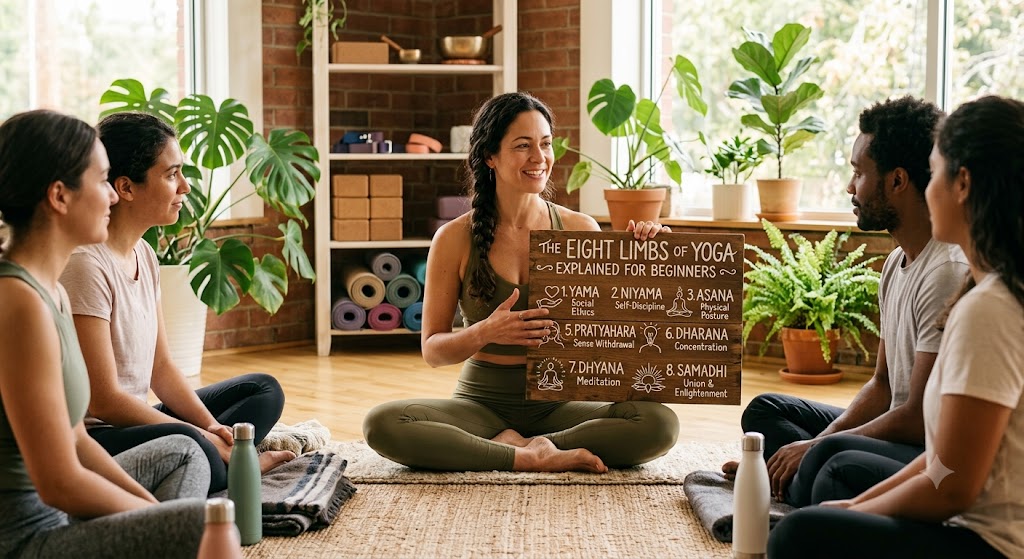
The eight limbs of yoga The following eight steps are laid down by the sage Patanjali in his ancient texts on Yoga, the Yoga Sutras. This system, the "ashtanga yoga" or "eight-limbed yoga" lays down the path of yoga as ethical principles, disciplinary effort, poses, breath control, sensory withdrawal, focus, meditation, and deepest absorption.
Beginners may appreciate learning about all of these steps that open their minds about yoga from simply one more physical pose. Yoga is connected to the way that we live, prepare, are, think and meditate.
What Are the Eight Limbs of Yoga?
The eight limbs of Yoga are Yama, Niyama, Asana, Prāṇāyāma, Pratyāhāra, Dhāraṇā, Dhyāna and Samādhi. In his Yoga Sutras Patañjali outlines the eight limbs of Yoga practice: The first six relate to ethics and discipline, the second six and beyond relate more and more to the body, breath, senses, concentration, meditation and intense mental absorptions.
Key Takeaways
The Eight Limbs of Yoga come from Patanjali's Yoga Sutras. They are also known as the eightfold path of yoga. The Sanskrit word ashtanga means “eight limbs.” Asana is only one of the eight limbs. Yama and Niyama describe ethical and personal practices. Pranayama involves regulation of the breath. Pratyahara relates to turning attention away from external sensory distractions. Dharana means concentration, while Dhyana refers to meditation. Samadhi represents a state of deep absorption. The eight limbs can be studied progressively, but they are also interconnected aspects of yoga practice
What Are the Eight Limbs of Yoga?
Patanjali describes eight limbs of yoga in the Yoga Sutras. They are:
Yama – ethical principles
Niyama – personal observances
Asana – posture
Pranayama – regulation of breath
Pratyahara – withdrawal or inward turning of the senses
Dharana – concentration
Dhyana – meditation
Samadhi – deep absorption
Together, these eight practices form a comprehensive framework for understanding yoga as more than physical exercise.
What Does Ashtanga Mean in Yoga?
The Sanskrit term Ashtanga can be understood as “eight limbs” or “eight-limbed.”
In the context of Patanjali's system, Ashtanga Yoga refers to the eight-limbed path described in the Yoga Sutras.
This is important because the term “Ashtanga Yoga” is also commonly used today to describe Ashtanga Vinyasa Yoga, a particular modern yoga practice associated with the lineage of Sri K. Pattabhi Jois.
These two uses of “Ashtanga” should not automatically be treated as identical.
Patanjali's Ashtanga Yoga: the eight-limbed philosophical and practical framework.
Ashtanga Vinyasa Yoga: a specific modern system of physical yoga practice.
Understanding this distinction helps beginners avoid a common source of confusion.
The Eight Limbs of Yoga Explained
1. Yama – Ethical Principles
Yama is the first limb of yoga and concerns ethical principles that guide how we relate to other people and the world around us.
Patanjali describes five Yamas:
Ahimsa – Non-Harming
Ahimsa means avoiding unnecessary harm in thought, speech, and action.
For a yoga practitioner, this can encourage compassion toward others as well as a less aggressive approach to one's own practice.
Satya – Truthfulness
Satya refers to truthfulness.
It involves developing honesty in communication and becoming more aware of the difference between what is true and what we simply want to believe.
Asteya – Non-Stealing
Asteya means refraining from taking what is not freely given.
It can also encourage awareness of how we use other people's time, energy, resources, and trust.
Brahmacharya – Responsible Use of Energy
Brahmacharya is traditionally interpreted in different ways depending on the context and school of yoga.
It is often associated with moderation, responsible use of energy, and disciplined living.
Aparigraha – Non-Grasping
Aparigraha refers to non-grasping or reducing excessive attachment to possessions and outcomes.
It encourages practitioners to examine the tendency to accumulate or hold on unnecessarily.
2. Niyama – Personal Observances
Niyama is the second limb and focuses more on personal discipline and inner development.
There are five Niyamas:
Saucha – Purity or Cleanliness
Saucha refers to cleanliness and purification.
It can include external cleanliness as well as cultivating clarity and awareness in one's inner life.
Santosha – Contentment
Santosha means contentment.
It encourages appreciation of the present while continuing to grow without being constantly driven by dissatisfaction.
Tapas – Discipline
Tapas can be understood as disciplined effort or committed practice.
It represents the willingness to maintain practices that support personal development.
Svadhyaya – Self-Study
Svadhyaya means self-study.
It can involve observing one's thoughts and behavior as well as studying relevant teachings or sacred texts.
Ishvara Pranidhana – Surrender to a Higher Principle
Ishvara Pranidhana is often translated as surrender or dedication to Ishvara, a higher principle or divine reality.
Interpretations vary among yoga traditions.
Yamas and Niyamas: What Is the Difference?
The easiest way for beginners to remember the distinction is:
| Yama | Niyama |
|---|---|
| Ethical principles | Personal observances |
| Focuses on relationships and conduct | Focuses on personal discipline |
| Five principles | Five principles |
| Ahimsa, Satya, Asteya, Brahmacharya, Aparigraha | Saucha, Santosha, Tapas, Svadhyaya, Ishvara Pranidhana |
Together, Yama and Niyama establish an ethical and disciplined foundation for yoga practice.
3. Asana – Posture
Asana is the third limb.
The modern trend in fitness culture now views yoga as almost entirely about body poses. As part of Patanjali's eight-limbed system, asana makes up only one of the eight parts to yoga.
Traditionally, asana referred to the creation of a stable, easeful posture for practicing.
Modern yoga ranges all sorts of postures, sequences, and different movement styles, but yoga as presented in Patanjali's works does not consist of the huge list of postures found in most yoga classes today.
For beginners, this distinction is important:
Yoga is broader than asana.
4. Pranayama – Regulation of Breath
Pranayama is the fourth limb.
The word is commonly associated with yogic breathing practices and the regulation of breath.
Traditional pranayama practices can involve aspects such as:
Breath awareness
Inhalation
Exhalation
Breath retention
Regulation of breathing patterns
Different yoga traditions teach pranayama differently, so beginners should learn techniques from an appropriately qualified teacher rather than assuming that every breathing practice is suitable for everyone.
What Is Kumbhaka?
Kumbhaka refers to breath retention in pranayama.
It can involve retention after inhalation or after exhalation, depending on the technique.
Because breath retention can be more demanding than simple breath awareness, beginners should approach advanced kumbhaka practices gradually and under appropriate instruction.
5. Pratyahara – Withdrawal of the Senses
Pratyahara is the fifth limb.
Often interpreted as withdrawal or introversion of the sense organs.
It doesn't necessarily refer to physical withdrawal from the world:
It means cultivating control over riding stimulus or the attraction of sensory experience so as to turn the attention inwards.
During meditation you might be aware of sounds and physical sensations and distractions, however you don't follow them.
Pratyahara acts as a gateway between those disciplines involving outer/preparatory works and those of concentration.
6. Dharana – Concentration
Dharana is the sixth limb and refers to concentration.
The practitioner intentionally places attention on a chosen object or point of focus.
That object could be:
The breath
A mantra
A visual object
A bodily sensation
A mental image
Another chosen meditation object
The goal is to develop the ability to keep attention directed rather than constantly moving from one thought to another.
7. Dhyana – Meditation
Dhyana is the seventh limb and is commonly translated as meditation.
It follows Dharana but represents a deeper continuity of attention.
A simple way to understand the distinction is:
Dharana: intentionally holding attention on an object.
Dhyana: sustained, continuous awareness of that object.
Meditation in this context is therefore not simply “relaxing” or emptying the mind. It represents a deeper development of sustained attention.
8. Samadhi – Deep Absorption
Samadhi is the eighth limb.
It is often translated as absorption, meditative absorption, or a state of profound concentration.
Traditional interpretations of Samadhi are complex, and different schools explain the concept in different ways.
For beginners, it is best understood as a state in which ordinary distinctions between the meditator, the process of meditation, and the object of meditation become profoundly transformed.
Samadhi represents the culmination of Patanjali's eight-limbed framework.
What Is the Eightfold Path of Yoga?
The term Eightfold Path of Yoga is another way of referring to the Eight Limbs of Yoga.
The eight components are:
Yama → Niyama → Asana → Pranayama → Pratyahara → Dharana → Dhyana → Samadhi
They can be viewed as a progressive framework, although it is better not to think of them as eight completely isolated steps.
Each limb supports the development of the others.
Are the Eight Limbs of Yoga a Step-by-Step Process?
They can be studied as a progression, but the relationship between the limbs is more nuanced than simply completing one before starting the next.
For example:
Ethical living can support meditation.
Physical practice can support steadiness.
Breath practices can influence attention.
Concentration supports meditation.
Meditation prepares the mind for deeper absorption.
Therefore, beginners can study the eight limbs together while gradually developing each aspect according to their experience and tradition.
What Are the Benefits of Studying the Eight Limbs of Yoga?
Learning the eight limbs can help beginners understand yoga as a holistic discipline rather than only a physical workout.
Potential benefits include developing:
Greater awareness of personal behavior
A stronger understanding of yoga philosophy
More intentional practice
Better concentration
Greater appreciation of meditation
Understanding of the relationship between breath and attention
A broader perspective on ethical and disciplined living
These should be understood as potential outcomes of practice rather than guaranteed medical or psychological effects.
Eight Limbs of Yoga vs Modern Yoga Practice
Modern yoga classes frequently emphasize asana, sometimes combined with pranayama or meditation.
Patanjali's Eight Limbs of Yoga provide a much broader framework.
| Modern Yoga Class | Eight-Limbed Framework |
|---|---|
| Asana | Asana is one limb |
| Breathing | Pranayama |
| Meditation | Dhyana |
| Concentration | Dharana |
| Philosophy | Includes ethical and contemplative principles |
| Lifestyle | Yama and Niyama |
| Sense awareness | Pratyahara |
| Deep absorption | Samadhi |
This broader perspective can help practitioners understand why yoga has historically been regarded as a philosophical and contemplative discipline as well as a physical practice.
Eight Limbs of Yoga and the Yoga Sutras of Patanjali
The Yoga Sutras of Patanjali are a foundational text in the history of classical yoga philosophy.
The eight-limbed framework is presented in the portion of the text traditionally associated with the practice (Sadhana) and is commonly identified with Sutra 2.29.
The eight limbs provide a framework for moving from ethical and personal disciplines toward concentration, meditation, and samadhi.
For students who want to explore yoga philosophy more deeply, studying the Eight Limbs alongside the Yoga Sutras can provide important historical and philosophical context.
Is Ashtanga Yoga the Same as Ashtanga Vinyasa Yoga?
No, not necessarily.
This is one of the most important distinctions beginners should understand.
Ashtanga Yoga, in Patanjali's context, means the eight-limbed path.
Ashtanga Vinyasa Yoga is a specific modern practice system associated with Sri K. Pattabhi Jois and the Mysore tradition.
Both use the word “Ashtanga,” but they refer to different contexts.
Is Ashtanga Yoga the Hardest Style of Yoga?
There is no objective ranking that makes Ashtanga the “hardest” yoga style.
Some modern Ashtanga Vinyasa practices can be physically demanding because they involve structured sequences, repeated movements, strength, flexibility, coordination, and sustained practice.
However, difficulty depends on:
Individual fitness
Experience
Mobility
Teaching approach
Practice intensity
Modifications
Physical limitations
A challenging practice for one person may be manageable for another.
Can Beginners Practice Ashtanga Yoga?
Yes, beginners can learn Ashtanga Vinyasa Yoga, provided they start at an appropriate level and receive qualified instruction. Beginners should not feel pressured to immediately perform advanced postures. A good teacher can help students understand: Fundamental postures Breathing Movement coordination Safe modifications Appropriate progression Rest and recover
Ashtanga vs Vinyasa: Which Is Better?
Neither is universally better.
Ashtanga Vinyasa generally follows a more structured sequence and traditional practice format.
Vinyasa Yoga is a broader category of flow-based practices in which teachers may create different sequences.
| Ashtanga Vinyasa | Vinyasa Yoga |
|---|---|
| More structured sequence | Usually more variable |
| Traditional lineage-based method | Many teaching styles |
| Strong emphasis on consistent practice | Often emphasizes creative sequencing |
| Can be physically demanding | Difficulty varies widel |
| Progression through established sequences | Sequence varies by teacher/class |
Choose based on your goals, preferred learning style, physical needs, and teacher.
Who Is Known as the Father of Ashtanga Yoga?
The answer depends on what you mean by “Ashtanga Yoga.”
Patanjali is traditionally associated with the systematic presentation of the eight-limbed path in the Yoga Sutras.
For Ashtanga Vinyasa Yoga, Sri K. Pattabhi Jois is the central modern teacher associated with its development and global spread.
Therefore, it is more accurate to avoid calling one person simply “the father of Ashtanga Yoga” without explaining the context.
How Can Beginners Practice the Eight Limbs of Yoga?
You do not need to master all eight limbs immediately.
A beginner might begin by:
Learning the basic principles of Yama and Niyama.
Developing a consistent asana practice.
Becoming aware of the breath.
Learning simple pranayama from a qualified teacher.
Practicing focused attention.
Introducing meditation gradually.
Studying foundational yoga philosophy.
Exploring deeper practices as experience develops.
The aim is not to rush toward the final limb. The eight-limbed path is traditionally understood as a process of sustained practice and development.
Frequently Asked Questions
hat are the 8 limbs of yoga?
The eight limbs are Yama, Niyama, Asana, Pranayama, Pratyahara, Dharana, Dhyana, and Samadhi. Together they form the eight-limbed framework described by Patanjali.
What are the five Yamas?
The five Yamas are Ahimsa, Satya, Asteya, Brahmacharya, and Aparigraha.
What are the five Niyamas?
The five Niyamas are Saucha, Santosha, Tapas, Svadhyaya, and Ishvara Pranidhana.
What is another name for the Eight Limbs of Yoga?
They are commonly called the eightfold path of yoga or eight-limbed path.
Is Ashtanga Yoga the same as the Eight Limbs of Yoga?
In Patanjali's context, Ashtanga Yoga means the eight-limbed path. However, Ashtanga Vinyasa Yoga is a specific modern yoga system, so the terms should be distinguished according to context.
What is the hardest yoga style?
There is no universally accepted “hardest” yoga style. Physical difficulty varies according to the practitioner, teacher, style, and level of practice.
Can beginners do Ashtanga Yoga?
Yes. Beginners can learn Ashtanga Vinyasa Yoga with appropriate instruction and gradual progression.
What is Kumbhaka?
Kumbhaka is breath retention within pranayama practice. Advanced breath-retention techniques should be learned gradually and under qualified instruction.
Who should not practice Kumbhaka?
People should not assume that intensive breath retention is suitable for everyone. Individuals with health concerns, pregnancy, or other circumstances that may affect breathing practice should seek appropriate professional guidance before attempting advanced techniques.
Which pranayama is the most powerful?
There is no objectively “most powerful” pranayama for everyone. Different techniques have different traditional purposes and levels of difficulty. Beginners should choose practices appropriate to their experience and learn advanced techniques from a qualified teacher.
Final Thoughts
An eight-limbed system to deepen and broaden your Yoga. Beyond Asanas to ethical and personal guidance yoga is about how to experience life: through practice (asana), regulation (pranayama), focusing of our five senses (pratyahara), creating focus (dharana), meditation (dhyana) and profound absorption (samadhi). Most importantly, the beginner needs to take the message that yoga is not about touching your toes.
Yoga, viewed through this eight-limbed model, is about the experience of life through practice, focus and life guidance.
It goes without saying, reading the Yoga Sutras alongside qualified yoga teacher training can provide a good foundation to ensure this experience is a positive one.
Disclaimer: Yoga philosophy and traditional practices can be interpreted differently across lineages. This article provides an introductory overview and should not be treated as a substitute for instruction from a qualified teacher.