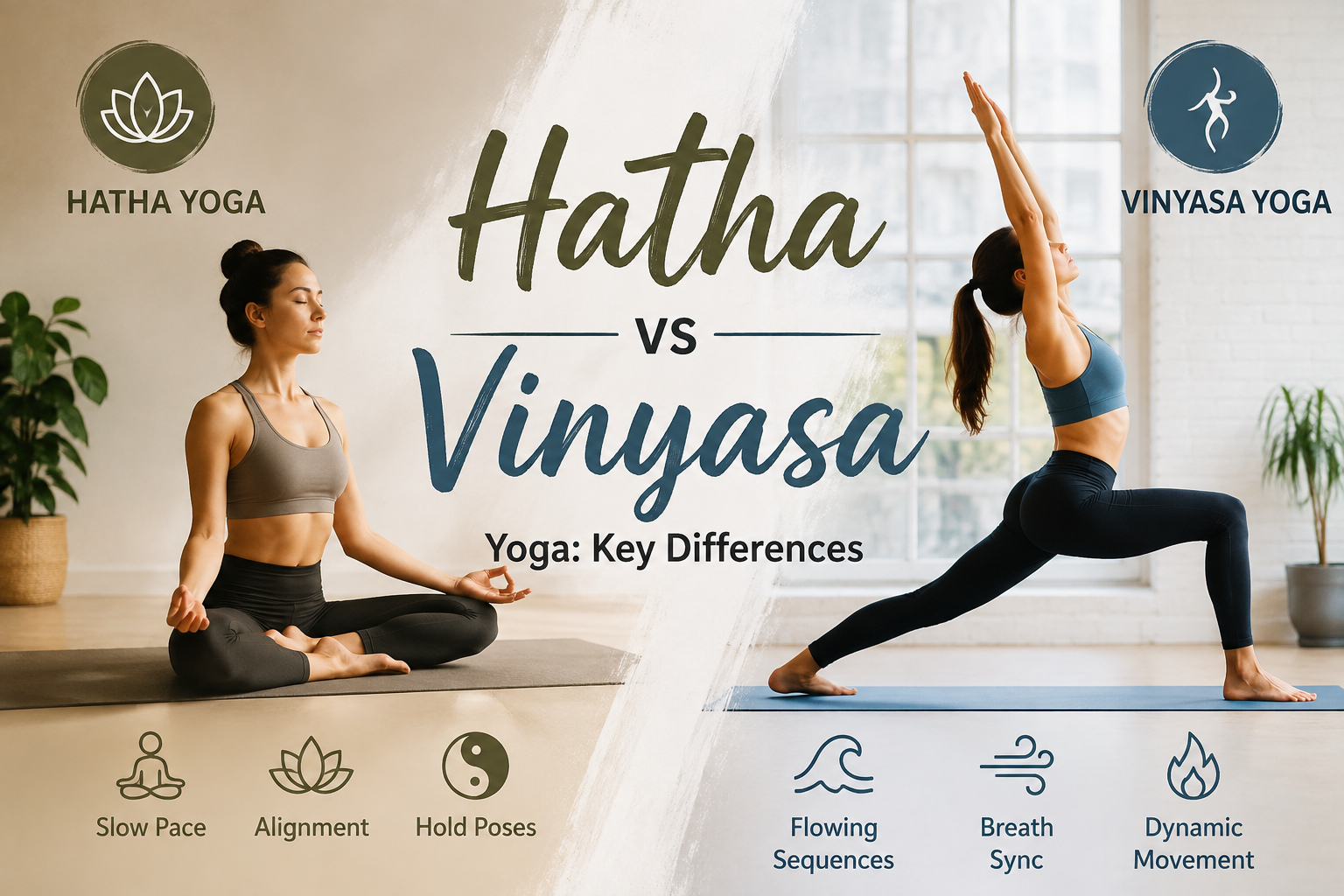
Deciding which style of yoga to practice can be a difficult decision. The more so when the styles of Hatha and Vinyasa seem to appear to hold many of the same poses. These styles of yoga are great for building strength, flexibility, balance, and body awareness and breath control-but they often feel very different.
So, Hatha versus Vinyasa Yoga, how do you choose?
The choice here may be more down to your individual level of experience and fitness, or if you prefer to flow between poses or hold them individually. While Hatha traditionally means holding a pose until you've got the feeling of it, the more dynamic Vinyasa linking sequences of poses through synchronized breath.
In this guide to Hatha vs. Vinyasa Yoga we can explain the subtle differences and try to answer frequently asked questions and determine which would be right for you.
Table of Contents
| S.No | Content |
|---|---|
| 1 | What Is Hatha Yoga? |
| 2 | What Is Vinyasa Yoga? |
| 3 | Hatha Yoga vs Vinyasa Yoga: The Main Difference |
| 4 | Hatha vs Vinyasa Yoga Comparison Table |
| 5 | What Is Hatha Yoga Compared to Vinyasa? |
| 6 | Is Vinyasa a Type of Hatha Yoga? |
| 7 | Hatha Yoga vs Vinyasa Flow: What's the Difference? |
| 8 | Which Is Easier, Vinyasa or Hatha Yoga? |
| 9 | Hatha Yoga vs Vinyasa Yoga for Weight Loss |
| 10 | Hatha vs Vinyasa vs Ashtanga Yoga |
| 11 | Which Yoga Style Is Best for Beginners? |
| 12 | Which Style Should You Choose? |
| 13 | Frequently Asked Questions |
| 14 | Final Thoughts |
What Is Hatha Yoga?
“Hatha is a general traditional method of yoga that utilizes bodily poses, breath manipulation, concentration, relaxation, meditation and meditation.” In recent yoga sessions, “Hatha” simply means an easy, rhythmic pace that goes about every pose. Instead of moving quickly around the postures, Hatha lets you remain in each pose for long periods so that you can be aware of your breath, body alignment as well as other important aspects. This makes this ideal for anyone wanting to take it the next step.
What Does a Hatha Yoga Class Usually Include?
A Hatha class may include: There isn’t one specific way this will go, as different teachers do things differently depending on their training and tradition, but I’ll share the general structure for an hour long class that we did at the beginning of my journey which was designed to be challenging yet restorative. Don't get me wrong, just because it's called Hatha doesn't mean it's easy! As with anything physical there are certain muscles involved (and some mental ones too!) We'll be working on our strength, mobility and balance - along with concentration and breathing technique. But unlike other styles where these sessions may run for 60 mins non-stop, in Hatha you have time to really delve into.Yoga poses (asanas)
Breathing exercises (pranayama)
Slow warm-ups
Alignment of the body
Extended poses
Stillness/rest poses
Mindfulness exercises/meditation
What Is Vinyasa Yoga?
It’s based on coordination between your breath and physical postures. Instead of holding each posture apart from the other ones for an extended period, you transition between them seamlessly as you flow through one movement after another. Because of this fluidity, Vinyasa is often linked with “flow yoga.” There isn’t a cookie-cutter Vinyasa experience, what you see and feel during class depends largely on who your instructor is and how they’ve structured their practice. For some teachers, you’ll enjoy a creative and energetic flow, while others will focus on slower, more flowing sequences. Some classes might even be very physically intense.
What Makes Vinyasa Different?
Vinyasa commonly emphasizes: Breath-synchronized movement Continuous transitions Creative sequences Coordination Strength and mobility Body awareness A changing class structure Some classes may move at an inconsistent tempo: a few might flow steadily and be easy to navigate at the speed the instructor proceeds through the poses. Others, not so much.
Hatha Yoga vs Vinyasa Yoga: The Main Difference
Hatha Yoga vs Vinyasa Yoga: The Main Difference
The biggest difference comes down to the flow or transitions between postures. In a typical Hatha class, you’ll arrive at a posture, find your alignment, hold it for a bit and take several breaths before shifting to the next. With Vinyasa yoga, the transitions between postures themselves are a huge piece of the practice, as you synchronize your breath and move seamlessly between different poses. To break it down very basically: Hatha = more time spent in static postures Hatha = stillness and awareness focus Vinyasa = more motion and flow Vinyasa = breath-linked movements That said, like I always tell new students-the lines get blurrier as you take more classes! I’ve certainly taught (and attended) plenty of Hatha classes with flowing sequences, and I’ve seen many Vinyasa classes with some longer holds.
Hatha vs Vinyasa Yoga Comparison Table
| Feature | Hatha Yoga | Vinyasa Yoga |
|---|---|---|
| Pace | Usually steady and slower | Usually flowing and dynamic |
| Movement | Individual postures with pauses | Continuous transitions |
| Breath | Used to deepen awareness and control | Used to coordinate movement |
| Class structure | Often more predictable | Frequently changes |
| Intensity | Low to moderate, depending on class | Low to high, depending on class |
| Main emphasis | Alignment, posture, breath and awareness | Flow, coordination and movement |
| Beginner-friendly | Yes | Yes, with an appropriate class |
| Flexibility | Strong focus | Developed through movement |
| Strength | Developed through postures | Developed through dynamic sequences |
| Best suited for | Foundation, awareness and steady practice | Movement, fitness and flowing practice |
The crucial thing is that one style doesn't have to be "better". It really comes down to the experience you want your practice to feel like.
What Is Hatha Yoga Compared to Vinyasa?
When a person searches for “What Is Hatha Yoga Compared to Vinyasa?”, they are likely wondering if the two types of classes vary in physical demand, flow or underlying goal. Generally, Hatha lends a bit more space to dive into and understand an individual pose before transitioning to another. Vinyasa prioritizes the transition from one pose to another. To illustrate, with an Hatha class you might transition to the Warrior II pose, sink into the posture, breathe for 5 breaths, hold your alignment and breath then Transition. With a vinyasa sequence this may be one of several posture transitions where movement is synchronized.They will add to the body’s core strength and flexibility, and also mental focus and balance.
Is Vinyasa a Type of Hatha Yoga?
This is one of the most asked questions in a Hatha/Vinyasa comparison. So, if you're wondering “is Vinyasa a type of Hatha yoga?”, the safest answer is: While there are bound to be many shared roots and influences between Hatha and Vinyasa, when modern yoga refers to Vinyasa Yoga it means a self-referential and flow. You might be wondering why this distinction is necessary. Well, the names of yoga types aren’t fixed across all traditions, styles, and studios/studios.
These two styles should not be viewed as two distinct realms. Physically, there are quite a few overlaps (asanas, focus on breath awareness) though how they are linked will vary slightly. Vinyasa is also a word that describes the connection of movement with the breath. Today in a modern yoga studio the term "Vinyasa Yoga" is generally synonymous with flowing yoga or categories of Hatha practice.
Hatha Yoga vs Vinyasa Flow: What's the Difference?
The Hatha yoga vs Vinyasa flow commonly refers to the difference between a practice that involves lots of poses and a practice that involves lots of movement. You may: Enter a posture Adjust your alignment Focus on breathing Hold the posture Observe sensations Move to the next posture You may: Begin with a breath Move into a posture Transition directly into another posture Continue coordinating breath and movement Build a sequence Finish with slower movements and relaxation Think of Hatha as giving you more opportunities to study the posture, while Vinyasa gives you more opportunities to experience movement between postures.Hatha
Vinyasa Flow
Which Is Easier, Vinyasa or Hatha Yoga?
Generally Easier For Beginners Hatha is more of a basic starting place for total beginners than a fast and dynamic Vinyasa course. A beginners Hatha class is typically a lot slower. This structure allows space for beginners to focus more on proper body alignment, fundamental movements and breathing practices. However… Vinyasa is not inherently hard in itself, a ‘Beginners Vinyasa’ or ‘Gentle Vinyasa’ class can use less challenging pose structures and gentler transitions. The question shouldn’t really be- ‘Which is easier, Vinyasa or Hatha Yoga?’ Instead ask- ‘Which class matches my existing experience and physical ability?’ -A slow Vinyasa may well feel easier than a strong and advanced Hatha practice. Each will have varying class levels, teaching styles, sequences and individual physical fitness aspects.
Hatha Yoga vs Vinyasa Yoga for Weight Loss
When deciding between Hatha yoga vs Vinyasa yoga for weight loss, remember that the practice of yoga should not be seen simply as a calorie-burning workout.
Vinyasa may contain greater continuous movement and thus more cardiovascular exercise than a slower paced Hatha class, perhaps presenting a greater physical demand depending on speed and intensity.
Hatha may be seen as beneficial, however, for providing a healthy way of managing weight by building muscle, flexibility, physical awareness, along with consistent activity.
Which Is Better for Weight Loss?
If a more energetic practice is key, Vinyasa might be the one to pick.
If establishing a sustainable, quality practice, stress reduction, and laying down fundamental poses are what you're focusing on then Hatha could be appropriate.
Ultimately weight management is related to "the bigger picture" including diet, total activity, sleep and consistency and personal preferences, rather than the style of yoga.
Hatha vs Vinyasa vs Ashtanga Yoga
Now let's add the third style: Ashtanga Yoga. Hatha, Vinyasa, and Ashtanga can overlap in physical postures and breath awareness, but their practice structures are different.
Hatha Yoga
Hatha generally emphasizes steady practice, individual postures, breathwork, alignment, and awareness.
Vinyasa Yoga
Vinyasa emphasizes flowing sequences where movement is coordinated with breath. Sequences can vary significantly between classes.
Ashtanga Yoga
Ashtanga Vinyasa however; has set sequences that are followed, and is more disciplined in its progression. Energy locks, gazing techniques, breathing principles are central in the practice.
So someone who loves variety might try Vinyasa; a person looking for a grounding practice, Hatha will work for them; someone with an affinity for repetition, structure, and progression, Ashtanga is a perfect fit.
Hatha vs Vinyasa vs Ashtanga: Quick Comparison
| Factor | Hatha | Vinyasa | Ashtanga |
|---|---|---|---|
| Pace | Steady | Flowing | Dynamic |
| Sequence | Often flexible | Usually creative | Structured |
| Movement | More pauses | Continuous transitions | Continuous and prescribed |
| Breath | Breath awareness | Breath-led movement | Strong breath focus |
| Variety | Moderate to high | High | More structured |
| Physical demand | Depends on class | Depends on class | Generally demanding |
| Best for | Building foundations | Flow and movement | Discipline and progression |
The three styles can therefore serve different preferences without one being universally superior.
Which Yoga Style Is Best for Beginners?
As a beginner to yoga in general, you may find Hatha an easy entry point, due to the slower pace which allows you to work on the basic poses and breathing elements.
However, you can also use Vinyasa or Ashtanga as a beginner with adequate guidance and adjustments.
Choose Hatha if you:
Are completely new to yoga Want to learn basic postures Prefer a steady pace Want more time to focus on alignment Enjoy a calmer practice
Choose Vinyasa if you:
Enjoy continuous movement Like variety in your workouts Want a more dynamic practice Enjoy coordinating breath with movement Prefer flowing sequences
Choose Ashtanga if you:
Like structured routines Enjoy repetition and discipline Want a physically challenging practice Prefer a progressive system Are willing to develop your practice gradually
Your first class does not have to determine your lifelong yoga style. You can explore different approaches and discover what works best for your body and goals.
Hatha vs Vinyasa: Which One Should You Choose?
Still unsure? Use your goal as the starting point. For learning the foundations: Choose Hatha. For flowing movement: Choose Vinyasa. For a structured and disciplined practice: Explore Ashtanga. For a calmer, steadier session: Hatha may be a good fit. For a more dynamic session: Vinyasa may suit you better. Above all else, do not pick a style simply because it looks more sophisticated. A practice which can be performed safely and regularly will generally be far more beneficial than one that is slightly outside one's ability.
Common Mistakes When Choosing Between Hatha and Vinyasa
Choosing based only on calorie burn
Yoga offers more than physical exertion. Strength, flexibility, breathing, concentration, and awareness are also important parts of the practice.
Assuming Hatha means “easy”
A slower class can still challenge your muscles, balance, flexibility, and concentration.
Assuming every Vinyasa class is fast
Vinyasa classes can range from gentle and slow to highly dynamic.
Comparing your progress with other practitioners
Yoga is an individual practice. Your flexibility, strength, mobility, and experience may be completely different from someone else's.
Ignoring the teacher and class level
The same yoga style can feel very different depending on how a teacher structures and guides the class.
Frequently Asked Questions
What is the main difference between Hatha and Vinyasa Yoga?
Both Hatha and Vinyasa yoga focus on breath control and the body, but Hatha styles are slower paced and more focused on individual poses and stability, whereas Vinyasa styles link poses to the breath to create a flowing sequence.
Is Vinyasa harder than Hatha?
A typical Vinyasa class may feel more physically demanding because of continuous movement, but difficulty depends on the class pace, sequence, teacher, and your experience.
Which is better for beginners: Hatha or Vinyasa?
Hatha may be a more welcoming way to begin for new students. Because of its measured rhythm it may give the opportunity to learn postures and breath patterns. Beginner’s level may also work.
Can Hatha Yoga help with weight loss?
HathaYoga can help with a healthy lifestyle by increasing the strength, the mobility and the consciousness of the body. However, the weight issue depends on multiple factors like alimentation and the general level of physical activity.
Is Vinyasa a type of Hatha Yoga?
Vinyasa is very similar to Hatha Yoga and other styles as a foundational base has shared common grounds, modern Vinyasa Yoga as is commonly taught now is usually characterized as its own fluid styles.
What is Vinyasa Yoga?
Vinyasa Yoga is a style of yoga that links breath to movement and poses with fluid transitions.
What is Hatha Yoga?
HathaYoga broad or holistic approach in that the aim can be anything, or many things like physical practices, breathing… Today when you come into a modern Hatha Yoga class we usually refer to slower practice focus on posture (asana), breathing (pranayama),alignment and awareness.
Which is better: Hatha, Vinyasa, or Ashtanga?
There’s no outright winner. Hatha can be good for those who are looking for a firm foundation; Vinyasa is well suited for someone who likes flowing from one movement to another; Ashtanga may be best for those who need more structure and controlled steps.
Final Thoughts: Hatha vs Vinyasa Yoga
Deciding Between Hatha vs Vinyasa Yoga The ‘best’ choice really depends on your intentions and personal preferences for a yoga practice: If you are looking to relax, feel at ease, give yourself space to breathe into poses, develop your breath-work, and cultivate mindful space, Hatha Yoga may be just for you! In Vinyasa Yoga poses often flow from one movement to the next synchronised with your breathing. A more structured practice that incorporates a fixed series of poses is for those that want repetitive routines like a challenge may find themselves Drawn To Ashtanga Yoga. However, style is something that you do not necessarily have to base upon which is the most difficult. Choose one that is in line with what stage of the practice you are in and what you are wanting to do and explore- let your practice simply evolve on its own accord. In Rishikesh, you are at the prime place if you seek to get closer to some of the more established forms of the practice, and can provide you the best understanding of how, under expert supervision you learn not the pose, but the practice of such including its breath work, alignment, discipline and awareness. Ultimately, whatever styles of yoga you practice, at the end of the day, is one, and one practice is truly your authentic one only when it's sustainable, safely practiced with earnest desire.