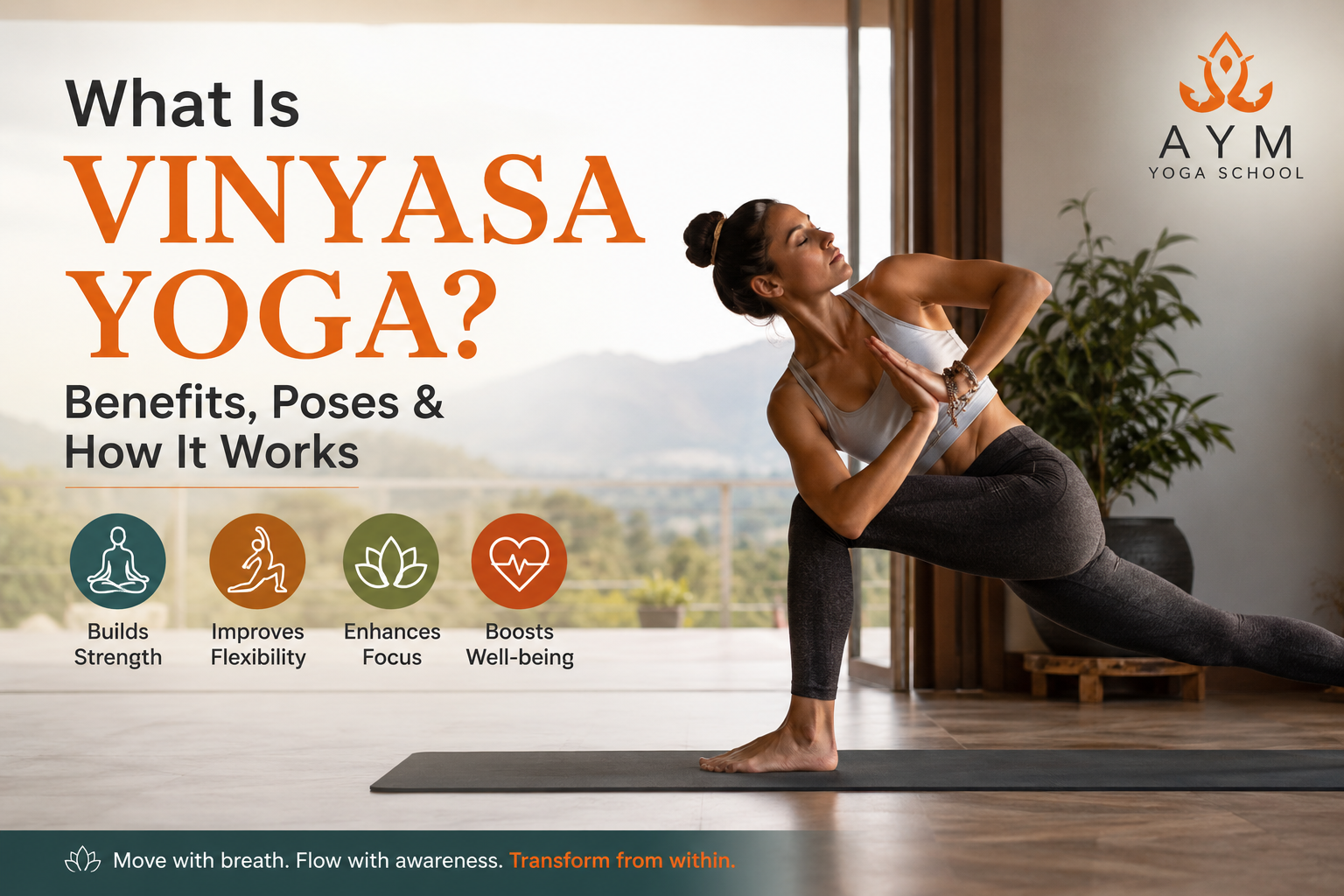
What Is Vinyasa Yoga and How Does It Work?
Vinyasa Yoga is an athletic style of yoga that links the physical posture of the yoga poses to the breath. While often defined as an arrangement and order for movement to occur, Vinyasa, when taken a step further, may define simply putting on a rhythm as you go through your series of postures that is connected to your breath. Vinyasa yoga involves flow from one posture to another, which creates a smooth series of movements rather than, for instance, holding each pose over and over again. The poses you might encounter are likely to involve walking posture, balancing position, stretches in your chair as well as on the ground and even some relaxation pose time depending on who is taking the lead and the level of class itself. For someone that is new to yoga, Vinyasa Yoga can be a fun class for strengthening, building flexibility, awareness of the body,Balance, breath work as well as seeing the different postures all put together in a cohesive flow.
What Is Vinyasa Yoga?
Vinyasa Yoga is typically a breath-work driven form of Yoga where posture and movement sync up to facilitate movement and flow between forms. Typically for a Vinyasa class each motion or pose is tied with either an inhale or an exhale. An inhale would accompany motions of opening and expanding, while an exhale would come during movements of folding and anchoring. Each studio or yoga instructor offers an exclusive Vinyasa Yoga series. This has also made for a practice that offers unique themes that will vary the tempo and series. In simple terms: Vinyasa Yoga = breath + movement + posture + flow. The practice can range from gentle and beginner-friendly sessions to physically demanding classes.
How Does Vinyasa Yoga Work?
With The Art of Yoga the goal isn't to perform each pose as an individual exercise. The practitioner connects each move to the breath. A typical sequence may look something like: Breath → Movement → Posture → Transition → Breath → Next Movement The specific order depends from class to class. For instance, one teacher may lead students from Mountain Pose to Forward Fold to Plank to Cobra or Upward-Facing Dog, then to Downward-Facing Dog and before continuing with the standing poses. The aim is to not just flow fast through the series. What’s important about good Vinyasa practice is mindful movement, coordination of breathing, correct form and an understanding of one’s own body.
What Happens in a Vinyasa Yoga Class?
A Vinyasa class can vary depending on the instructor, level, and purpose of the session. However, many classes include several common stages.
1. Centering and Breath Awareness
The class may then start with a couple of minutes of quiet breathing & body awareness. This will get your students to be present in their body & ready for the practice.
2. Warm-Up Movements
Gentle movements and introductory postures help prepare the body for more active sequences.
3. Vinyasa Flow
The bulk of the class typically focuses on stringing together poses into a series of rhythmic movements. Students move and breathe together, following their instructor as they guide them from pose to pose.
4. Standing and Balancing Poses
The sequence may include standing postures, balancing poses, twists, or strengthening movements.
5. Cooling Down
The pace generally becomes slower toward the end of the practice, with seated or lying-down stretches.
6. Final Relaxation
Many classes finish with a period of relaxation, allowing the body and mind to settle after practice.
What Are the Benefits of Vinyasa Yoga?
Why is this popular with people? One is that Vinyasa blends physical motion with mindful breathing. Daily practicing can assist with several components of physical and psychological health and well-being..
1. Supports Flexibility
Moving through different postures can help develop flexibility and mobility over time. Consistency is more important than forcing the body into deeper positions.
2. Builds Strength
Some Vinyasa sequencing can necessitate that you hold and manage body weight through transitions, standing postures, plank modifications, and balancing postures can give you opportunities to challenge multiple muscle groups at one time.
3. Improves Balance and Coordination
Transitions require control of your breath to do properly. Balancing poses would help continue to refine control over your body.
4. Encourages Breath Awareness
As movement is paired with breath, students practice being more in tune to their breath and utilizing it as part of their practice.
5. Supports Mindfulness
Following the breath and movement can encourage concentration and present-moment awareness.
6. Provides a Physically Active Practice
Depending on the pace and sequence, Vinyasa can provide a more active yoga session than slower styles.
7. Helps Develop Body Awareness
The consistent practice develops our understanding of posture, our movements, our muscles, and any limitations we possess.
Vinyasa Yoga Poses: Which Poses Are Commonly Practiced?
There is no universal list of Vinyasa Yoga poses because Vinyasa refers more to the way postures are connected and practiced than to one fixed group of poses. Some commonly incorporated postures include: Mountain Pose (Tadasana) Downward-Facing Dog (Adho Mukha Svanasana) Plank Pose Chaturanga Dandasana Cobra Pose (Bhujangasana) Upward-Facing Dog (Urdhva Mukha Svanasana) Warrior I (Virabhadrasana I) Warrior II (Virabhadrasana II) Triangle Pose (Trikonasana) Chair Pose (Utkatasana) Tree Pose (Vrikshasana) Child's Pose (Balasana) The teacher may modify these poses or arrange them differently according to the class level and objective.
Is Vinyasa Yoga Difficult for Beginners?
Beginners can definitely find Vinyasa Yoga intimidating, yet it really does not need to be overly strenuous if you're doing it at the right level for you. What causes the struggle to be real is the coordination of breath, movement, balance, strength, and transitions all at the same time. It takes a while to remember sequences for beginners to keep up. Totally fine. Beginners can make the practice more accessible by: Starting with a beginner-level class Learning basic yoga postures first Moving at a controlled pace Using modifications when necessary Focusing on breathing rather than speed Listening to the teacher's alignment instructions Taking rest when needed The goal is not to perform every transition perfectly. Developing awareness and control gradually is more important.
Is Vinyasa Yoga Harder Than Normal Yoga?
No – because ‘normal yoga’ might be Vinyasa. Or it might be Restorative. Or something in between. Vinyasa is more physically strenuous on many occasions than slower forms because of all the moving and sequencing. But the level of intensity all depends on the sequencing, speed of the class, your experience and the teacher. For instance, a gentle morning flow Vinyasa class might not even begin to challenge a seasoned yoga practitioner, whereas in an advanced fast flow you could barely take a breath.
What Are the 5 Pillars of Vinyasa Yoga?
The exact terminology can vary between yoga schools and teachers, so there is not one universally accepted list called the “five pillars of Vinyasa Yoga.” However, Vinyasa practice can be understood through five important principles:
1. Breath
Breathing provides an important foundation for coordinating movement and developing awareness during practice.
2. Movement
Vinyasa uses intentional movement to transition between postures.
3. Alignment
Understanding how to position the body safely and effectively helps practitioners develop better control of each posture.
4. Awareness
Mindful attention helps practitioners notice their breath, body, movement, and mental state during practice.
5. Flow
The relation between movements, transitional poses and breathing give Vinyasa its fluidity.
These principles might guide beginners to find out that Vinyasa is not just transitioning from pose to pose really fast.
Is Vinyasa Yoga Good for Weight Loss?
Vinyasa yoga can lead to a more active way of life and may be beneficial for weight management when combined with a healthy diet and with regular exercise, rest and other lifestyle choices.
As it may involve linking poses with no rest between them, Vinyasa is an exercise that is physically more demanding of a greater energy expenditure than, for instance, very gentle forms of yoga.
However, it is important to see Vinyasa yoga not as a definitive weight-loss solution as the amount of weight loss attributed to this method will be different from individual to individual and the intensity of the class may vary and be influenced by diet and general physical activity. As far as the reduction of weight is concerned, regularity and sustained habits should more probably replace reliance solely on calories "burnt" during the yoga class.
Is Vinyasa Yoga Healthy?
Many people can find Vinyasa Yoga a wholesome contribution to their well-rounded routine. Its structure integrates physical postures, transitions, breath, focus, and savasana (rest). Consistent Vinyasa might lead to increased mobility and flexibility, strength, balance, motor control and a heightened sense of mindful awareness. However, in physical terms, the poses practiced must be in line with your body's capability. A beginner practicing Vinyasa should refrain from holding and overstressing a complicated pose and avoid tricky pose transitions while building strength and controlling the musculature. A relevant medical condition or injury could be addressed with expert knowledge prior to engagement in a highly physical practice.
How Many Times a Week Should I Do Vinyasa Yoga?
The ideal frequency depends on your experience, fitness level, schedule, and the intensity of your sessions. For someone new to Vinyasa, starting with 2–3 sessions per week can provide an opportunity to build familiarity without making the practice overwhelming. As your body becomes accustomed to the movements, you may choose to practice more frequently if it feels appropriate. A balanced weekly routine might include: 2–3 Vinyasa sessions for beginners Rest or lighter movement between demanding sessions Additional gentle stretching, walking, meditation, or other activities Consistency matters more than practicing intensely every day.
Is Vinyasa Yoga Good for Beginners?
Yes! You are able to practice VinyasaYoga, as long as you attend an
“all levels” yoga class that allows students to move at their own speed according to the level that you are ready to approach.
A beginner class for VinyasaYoga, will introduce beginner posture, breathing awareness, basic alignment, transitions between postures before working the more complex sequence as you are ready.
If you have never taken a yoga class before you may want to take a few yoga poses and breathing classes before you jump into a high-speed vinyasa yoga class.
Tips for Your First Vinyasa Class
Arrive early and tell the teacher that you are a beginner. Wear comfortable clothing that allows free movement. Bring water if appropriate for the class environment. Do not worry about keeping up with experienced practitioners. Use modifications when offered. Rest in Child's Pose whenever you need a break. Focus on steady breathing. Avoid comparing your flexibility or strength with others.
Vinyasa Yoga vs Other Yoga Styles
Vinyasa is one of several approaches to yoga, and each style can provide a different experience.
| Yoga Style | General Character | Movement |
|---|---|---|
| Vinyasa | Breath-connected flowing sequences | Moderate to dynamic |
| Hatha | Postures with emphasis on alignment and awareness | Generally slower |
| Ashtanga | Structured and progressive sequence | Dynamic |
| Yin | Longer-held passive postures | Slow |
| Restorative | Supported, relaxing postures | Very gentle |
These descriptions are general. Individual classes can vary considerably depending on the teacher and school.
What Is Vinyasa Yoga and How Does It Work? — Quick Answer
This is one kind of yoga flow, that integrates breath movement in an active and fluent way. By flowing from one posture to the other, the sequence of postures is always linked with your inhales and exhales. They can of course change on teacher level, what that leads to, the fact that Vinyasa can be adapted to students of all levels.
Frequently Asked Questions About Vinyasa Yoga
Is Vinyasa yoga difficult for beginners?
For beginners it can be intimidating because it combines the elements of movement, breath, transitional flow, and balance. But a basic level class can make this kind of flow doable and fun with just using less difficult sequencing and more modifications.
Is Vinyasa yoga harder than normal yoga?
Why Vinyasa is more than simply a harder way to do yoga Vinyasa can be an physically rigorous class due to constant moving and is harder than its more passive or slower cousins. The rigor varies based on class and sequencing but also the level of practitioners.
What are the 5 pillars of Vinyasa yoga?
You won't find one established five-pillar approach to Vinyasa yoga, but breath, alignment, movement, awareness and flow are helpful as guidelines to understand how the practice works.
Is Vinyasa yoga good for weight loss?
Vinyasa can be part of an active lifestyle and may support weight-management goals, particularly when practiced consistently alongside balanced nutrition and other healthy habits.
What are the benefits of Vinyasa Yoga?
Potential benefits include improved flexibility, strength, balance, coordination, breath awareness, mindfulness, and body awareness.
How many times a week should I do Vinyasa yoga?
This can be 2-3 sessions per week for total beginners and can gradually increase depending on your own experience, recovery, available schedule and overall class intensity.
Is Vinyasa yoga healthy?
Perhaps a way to address some of these issues is by integrating Vinyasa in the life of individuals who see it as fit for them. Choosing the level of the class and using the correct method, you may benefit from this practice for a long time.
Start Your Vinyasa Yoga Journey with AYM Yoga School
Discovering Vinyasa Yoga in Rishikesh is a great place to start. But learning breath movement, alignment and transition with qualified teachers in our school to support your practice a lot. Learn how to practice asana, pranayama, meditation and Yogic Philosophy with a Traditional Yoga Teacher Training course in Rishikesh at AYM Yoga School. This program is perfect for those who are just starting with yoga or already practicing to learn and develop awareness and confidence while practicing yoga. Start Vinyasa yoga practice in the traditional way by enrolling in a yoga teachers training course in Rishikesh, AYM Yoga School India.
Final Thoughts
Vinyasa Yoga isn't just a set of postures; the way in which our breath and movement intertwine is what makes this style unique. The experience itself may feel flowing, intense, mindful or relaxing-depending on how the sequence is put together. You don't need to be flexible or experienced to give the style a try; what is most important is that you select the class appropriate for you, learn the fundamentals and follow where it takes you, comfortably, at your own pace. If committed to, and if integrated responsibly, Vinyasa could well become one part of a healthy yoga life.