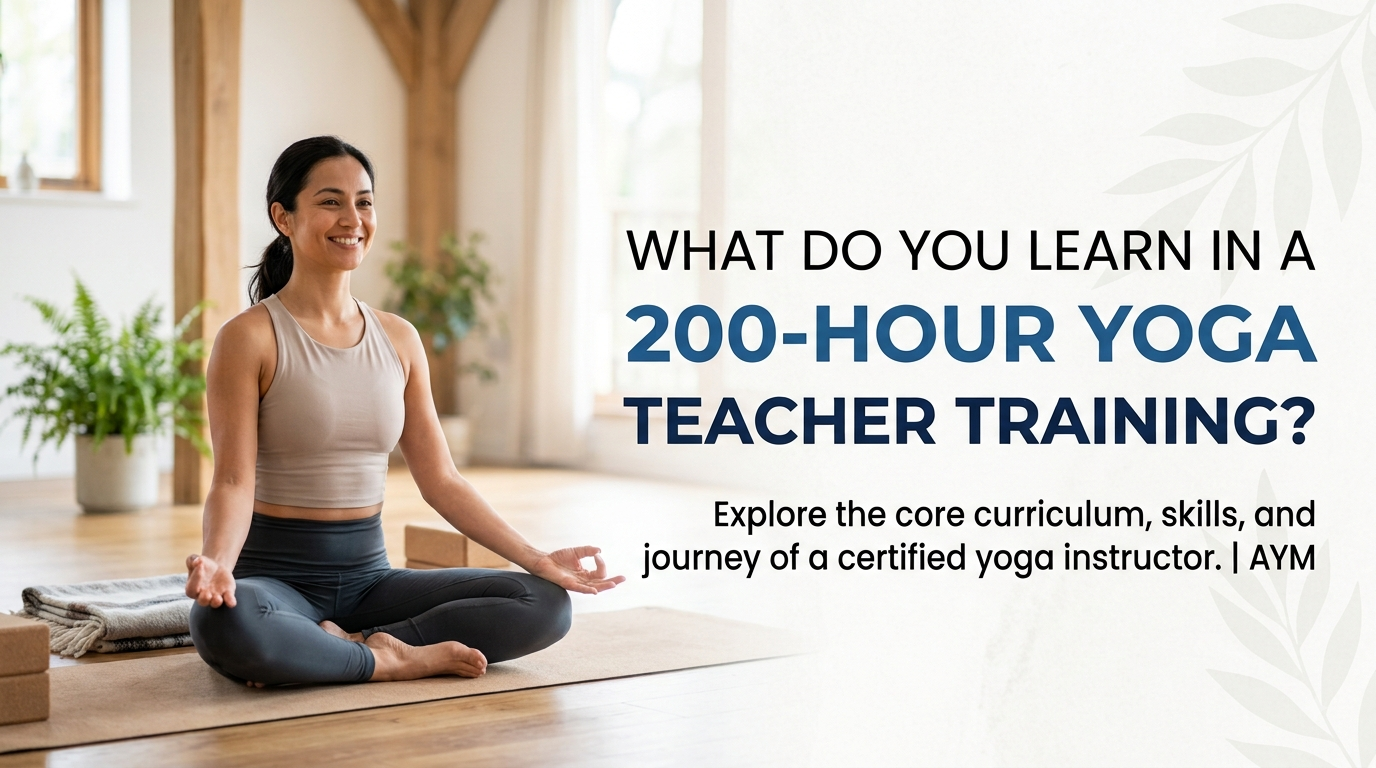
A Yoga teacher training course is designed to help you learn more about yoga so you can practice and teach it to others. You will learn about yoga poses. How to do them correctly, breathing exercises, meditation, the human body and how it works, the ideas behind yoga, how to teach yoga and how to put together a class. In a 200-hour program, you will study these things and more, like how to teach yoga and how to be a teacher.
A 200-hour yoga teacher training is a way for people to learn more about yoga and start teaching it to others. The things you learn can be different depending on the school and the style of yoga they teach. The Yoga Alliance has a way of organising what you learn in a 200-hour yoga teacher training. They divide it into four parts: how to do yoga poses and other practices, how the human body works, the history and ideas of yoga and what you need to know to be a yoga teacher.
At AYM Yoga School in Rishikesh, you should look at what you will learn, how you will learn it when the classes are, who your teachers are and what you need to do to get a certificate when you finish the 200-hour yoga teacher training course.
Table of Contents
What Is a 200-Hour Yoga Teacher Training Course?
A 200-hour yoga teacher training course is like a school for people who want to teach yoga. It teaches you about yoga, how to do it, how to teach it to others and all about the body and how it works.
The point of this course is not just to show you a lot of yoga poses. A good course will help you understand what yoga is about, how to explain it to others, how to put together a class and how to be a good teacher.
Yoga Alliance says that the RYS 200 course is a starting point for people who want to teach yoga. It covers things like how to do yoga, how the body works, the history of yoga and what you need to know to be a yoga teacher.
A typical yoga teacher training program may include:
Asana practice and alignment
Pranayama and breath awareness
Meditation and mindfulness
Yoga anatomy and physiology
Yoga philosophy and history
Teaching methodology
Class sequencing
Communication and demonstration skills
Ethics and professional responsibilities
Practice teaching and feedback
The exact curriculum depends on the school and its chosen style, lineage, and methodology.
What Do You Learn in a 200-Hour YTT?
In a 200-hour YTT, you learn both the knowledge behind yoga and the practical skills needed to guide others through yoga practices.
The main areas generally include:
These subjects correspond broadly with the curriculum areas emphasised by current RYS 200 standards.
Why Is This Combination Important?
Learning individual yoga techniques is only one part of becoming a capable teacher. You also need to understand how to explain practices, adapt instruction, recognise your professional limits, and create an environment where students can practice safely and respectfully.
Yoga Asanas & Alignment
One of the central components of a yoga teacher training course is learning yoga asanas in greater depth.
Instead of simply learning the names of poses, trainees typically explore:
Proper alignment principles
Foundations and actions of common postures
Different categories of asanas
Variations and modifications
Use of props
Common movement considerations
Verbal instructions and demonstrations
How to observe students during practice
You also learn how to explain a posture rather than simply perform it yourself.
For example, a teacher may need to describe how students can establish a stable foundation, organize their posture, coordinate movement with breath, and choose an appropriate variation.
What Is the Goal of Asana Training?
The goal is to develop enough understanding to practice and teach asanas with clarity and responsibility, rather than memorising a list of poses.
Pranayama & Breathwork
Yoga teacher training has another part, which is Pranayama.
Pranayama is something that students really need to learn about. They learn about the principles behind the breathing practices of yoga. They find out how they can use breath awareness in their own practice and when they are teaching.
Depending on the program that they're in, students may learn about these things:
Basic awareness of breath
The different techniques of Pranayama
How to breathe properly when they are moving
How to get ready for Pranayama
How to teach Pranayama. Demonstrate it
How to use breathing practices in the way
Practices that help people relax and become more aware of their breath
A good yoga teacher training program will make sure that Pranayama techniques are taught in a way that's right for the students' level and that the teacher really understands what they are teaching about Pranayama.
Why Do Yoga Teachers Study Pranayama?
Teachers need more than the ability to perform a breathing technique themselves. They need to understand how to explain the practice clearly and guide students appropriately.
Meditation & Mindfulness
A yoga teaching course will also teach students about ways to meditate and be mindful.
Training includes a lot of things like
Concentration practices
Breath-based meditation
Guided meditation
Mindfulness
Awareness practices
Relaxation techniques
Establishing a meditation practice
Guiding students through meditation
Meditation education really helps future yoga teachers feel more comfortable when they need to create a space for stillness and reflection in a class.
The yoga teaching course will teach you about meditation methods, and these depend on the school you are going to and what they teach.
Yoga Anatomy & Physiology
Yoga anatomy and physiology are really important for students to learn about because they help us understand how our bodies work when we move and practice yoga. A program that trains people to be yoga teachers may cover a lot of topics such as: Major bones and joints Muscles and movement Basic body systems Range of motion Functional movement Breath and respiration system concepts Common movement considerations Applying what we learn about anatomy to teaching yoga The goal of learning yoga anatomy and physiology is not to make yoga teachers into doctors. Instead it helps yoga teachers understand movement better and teach yoga in a way. Yoga Alliance has standards for training yoga teachers and yoga anatomy and physiology are one of the areas they focus on. According to the current Yoga Alliance RYS 200 standards Anatomy & Physiology is one of the four core categories that are required
Why Is Anatomy Important for Yoga Teachers?
Anatomy can help teachers make better-informed decisions about demonstrations, verbal cues, modifications, and class planning while recognizing the limits of their professional role.
Yoga Philosophy & History
Yoga is more than a physical exercise system. A comprehensive yoga teacher training course also introduces students to the philosophical and historical foundations of yoga.
Depending on the program, students may explore:
History and development of yoga
Major yoga traditions
Yogic philosophy
The Yoga Sutras
The eight limbs of yoga
Yamas and niyamas
Meditation and self-study
Traditional concepts and terminology
How philosophical ideas relate to contemporary practice
Yoga Alliance places these subjects within its broader Yoga Humanities category for RYS 200 programs.
Why Study Yoga Philosophy?
Understanding yoga philosophy can help teachers place physical practices within a broader context and communicate the tradition with greater depth and respect.
Teaching Methodology
Learning yoga is one thing and learning to teach yoga is a different thing.
Teaching yoga is a skill that you can learn with the teaching methodology.
This methodology will help yoga instructor training program students develop the skills they need to teach a yoga class.
A yoga instructor training program may teach yoga instructor training program students things like
how to give instructions when you are teaching yoga
how to demonstrate yoga postures
how to observe the students who are taking your yoga class
how to offer modifications that are suitable for your yoga students
how to use language that is effective when you are teaching yoga
how to organize a yoga class
how to manage the transitions in a yoga class
how to communicate with the different students in your yoga class
how to give feedback that is helpful to your yoga students.
The main goal of a yoga instructor training program should be to help yoga instructor training program students learn how to teach yoga
A yoga instructor training program should help yoga instructor training program students move from knowing how to do yoga to being able to teach yoga and explain it in a way that is easy for their students to understand.
Class Sequencing & Lesson Planning
Another major part of a yoga teacher training course is learning how to create a coherent class. Students may learn how to: Establish a class intention or focus. Prepare students through appropriate warm-ups. Progress toward more demanding movements. Organize poses logically. Coordinate movement and breath where appropriate. Include modifications. Create suitable transitions. Allow time for cooling down and relaxation. Close the class appropriately.
What Makes a Good Yoga Sequence?
A good yoga sequence is more than a bunch of popular yoga poses.
It should have a purpose and a logical progression, from one yoga pose to the next.
The pacing of the yoga sequence should be appropriate. The yoga sequence should consider the students who are participating in the yoga class.
You may get to design your yoga sequences in your yoga teacher training classes, and you will get feedback from the instructors and the other people who are training to be yoga teachers.
Yoga Ethics & Lifestyle
Ethics play a role in being a responsible yoga teacher.
Training can cover topics like:
Yamas and niyamas
Respect for students
Professional boundaries
Consent
Inclusivity
Teacher-student relationships
communication
Scope of practice
Professional conduct
The Yoga Alliance's current ethical framework focuses on honesty, being inclusive, showing respect in teacher-student relationships using touch with consent and being open in communication.
Its Scope of Practice also says teachers should teach within their qualifications, experience and skills and make sure they get informed consent before making physical adjustments.
Why Does Ethics Matter in Yoga Teaching?
A yoga teacher works directly with people. Technical knowledge alone is not enough; responsible teaching also requires appropriate boundaries, respect, communication, and awareness of professional limitations.
Practical Teaching & Practicum
Theory becomes much more useful when trainees have opportunities to practice teaching.
Practical components of yoga instructor training may include:
Teaching individual postures
Giving verbal instructions
Demonstrating techniques
Leading short sequences
Teaching complete practice sessions
Observing other trainees
Receiving instructor feedback
Improving communication
Developing confidence
Yoga Alliance's RYS 200 standards state that schools should assess trainees' knowledge, skills, and experience before issuing a 200-hour training certificate.
This makes practical assessment an important part of understanding whether a trainee can apply what they have learned—not simply whether they attended classes.
What Certification Do You Receive?
One of the most common questions about a yoga teacher training certification is what students receive after completing the program.
Generally, a student who completes a school's 200-hour teacher-training program may receive a 200-hour training certificate, subject to that school's requirements and applicable credentialing framework.
However, it is important to distinguish between a school's training certificate and a professional credential.
For example, Yoga Alliance distinguishes:
RYS 200 - Registered Yoga School
Credential for schools offering a qualifying 200-hour program
RYT 200 - Registered Yoga Teacher
The certificate for teachers who fulfill the requirements.
Yoga Alliance calls RYT 200 the 200-hour teacher certificate and has different rules for teacher registration.
So before signing up make sure what your selected school offers when you finish and whether more registration, membership, teaching experience or other conditions are needed for the certificate you are looking for.
Who Should Take a 200-Hour Yoga Teacher Training?
A 200-hour yoga teacher training course can be suitable for different types of students.
You may consider a program if you:
Want to become a yoga teacher
Want to deepen your personal yoga practice
Want to understand yoga beyond asana
Want to study yoga philosophy and anatomy
Want structured education in yoga
Want to develop teaching and communication skills
Are considering yoga as a professional path
You do not necessarily need to be an advanced practitioner capable of performing every difficult yoga pose.
What matters more is your commitment to learning, practising consistently, receiving feedback, and engaging seriously with the educational process.
Yoga Alliance describes 200-hour training as a foundational pathway for people beginning their journey toward becoming a credentialed yoga teacher.
What Are the Yoga Teacher Training Requirements?
Requirements vary between schools and programs. Before enrolling, check:
Minimum age requirements, if applicable
Previous yoga experience
Attendance requirements
Required assignments or practice
Assessment procedures
Training schedule
Course format
Certification requirements
Registration or credentialing requirements
There is no universal assumption that every yoga teacher training program has identical admission requirements or curricula, so prospective students should verify the requirements directly with the school.
Frequently Asked Questions
What do you learn in a 200-hour yoga teacher training?
In a 200-hour YTT, students typically study yoga asanas, alignment, pranayama, meditation, anatomy and physiology, yoga philosophy, teaching methodology, sequencing, ethics, and practical teaching.
Is a 200-hour yoga teacher training course enough to teach yoga?
A 200-hour program is generally considered foundational teacher training. Whether you can teach professionally, register with a credentialing organization, or meet local requirements depends on the program and the applicable credentialing or legal framework. Yoga Alliance, for example, has separate standards for RYS 200 schools and RYT 200 teachers.
What is included in a yoga teacher training syllabus?
A typical syllabus can include asana techniques, pranayama, meditation, anatomy and physiology, yoga philosophy, teaching methodology, sequencing, ethics, and practicum. The exact syllabus varies by school.
Do I need to be advanced at yoga before joining a 200-hour YTT?
Not necessarily. A 200-hour training is foundational, but individual schools can establish their own admission requirements and expectations. It is best to check the specific program before enrolling.
What is the difference between yoga teacher training and yoga instructor training?
The terms are often used interchangeably. However, programs can differ substantially in curriculum, teaching methodology, style, duration, and credentialing. Always review the actual syllabus and learning outcomes rather than relying only on the program name.
What certification do you get after a 200-hour yoga teacher training?
A completed program may issue a 200-hour training certificate according to the school's requirements. If you intend to pursue a specific professional credential, check the additional requirements of the relevant credentialing organization. Yoga Alliance, for example, separately defines RYS and RYT credentials.
Can beginners join a 200-hour yoga teacher training?
Many foundational programs are designed for students who are beginning their formal teacher-training journey, but admission requirements vary. Check the school's experience, attendance, fitness, and other requirements before enrolling.
How long does a 200-hour yoga teacher training take?
The calendar duration depends on how the school schedules its training hours. A 200-hour program may be delivered intensively or spread over a longer period. The number of calendar days or weeks is therefore not necessarily the same across all programs.
Final Thoughts
A yoga teacher training course is a lot more than just learning yoga poses. A good 200-hour program teaches you how to do yoga and also about the body, the ideas behind yoga, meditation, how to teach and how to put poses together. You also get to practice teaching with supervision.
The best thing you get from this course is not just remembering what is on the syllabus. It is really about getting the knowledge, learning how to talk to people, getting experience and understanding what it means to be a yoga teacher. This helps you keep growing as a yoga practitioner. Teach others in a responsible way when you are ready.
If you are looking at yoga teacher training programs, do not just think about how many hours they are. Look at what you will be learning, who's teaching, how they teach, how you will be tested, how you get certified, what rules they follow, the schedule and how they support students. Pick a program that fits what you want to do. It will make your training more worthwhile and helpful for your yoga journey in the long run.